


 PLATFORM UPDATE:

Polyaniline enhances the visible light photocatalytic activities of bismuth oxyhalides

Abstract
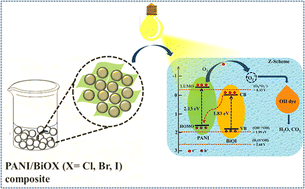
Formation of heterojunction nanocomposites is an effective strategy to improve the photocatalytic activities of semiconducting materials. While, the band structure of the pure materials may guide the design of the heterojunction, the effectiveness of the same will depend on a number of factors such as the type of heterojunction as well as the interfaces. This study investigates the effect of forming a heterojunction between polyaniline (PANI)–and bismuth oxyhalides (BiOX, X = Cl, Br, I) on their photocatalytic performance. The composites were synthesized via a simple room-temperature co-precipitation method. Photocatalytic evaluation of orange II (OII) dye as a model pollutant revealed that the PANI/BiOX composites exhibited significantly improved degradation efficiency compared to pristine PANI and bare BiOX counterparts. Notably, the PANI–BiOI (PBI) composite could photocatalytically remove 95.3% of 20 ppm OII dye within 180 min under visible light. PBI could also achieve 90% photoreduction of 100 ppm toxic Cr(VI) to Cr(III) within 50 min, indicating its superior redox capabilities under visible light. The observed enhancement in photocatalytic activities of the nanocomposites is attributed to synergistic effects including improved light absorption, favorable band edge alignment, and efficient separation of photogenerated charge carriers at the PANI–BiOX interface, thereby reducing recombination losses and enhancing catalytic activity. Reactive species trapping experiments confirmed superoxide radicals (˙O2−) as the primary oxidative species involved in the dye degradation mechanism. Based on optical and electrochemical findings, formation of a Z-scheme heterojunction is proposed in PBI. This work underscores the potential of PANI–BiOX composites as effective visible-light responsive photocatalysts for environmental cleanup, particularly in the treatment of harmful organic pollutants and heavy metals.
 Please wait while we load your content...


