


 PLATFORM UPDATE:


2D functionalized copper(ii)-carboxylate framework for efficient chemical fixation of carbon dioxide: insights from experimental and theoretical analysis

Abstract
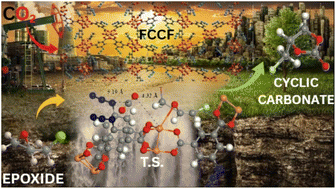
Metal–organic materials are an important class of heterogeneous catalytic materials that offer a variety of organic transformations. A 2D azide functionalized copper(II)-carboxylate framework (FCCF) was synthesized for catalytic application in the chemical fixation of carbon dioxide. The synthesized MOF was characterized using different techniques, i.e., FTIR, PXRD, SEM and TGA. Hirshfeld surface analysis was performed to assess intermolecular interactions. The catalytic potential of the FCCF for CO2 fixation to synthesize organic cyclic carbonates was investigated and optimized under solvent-free conditions and ambient CO2 pressure at 100 °C within 3–8 hours in the presence of a co-catalyst (tetrabutyl ammonium bromide). The complete conversion of epichlorohydrin into its cyclic carbonate with maximum selectivity was achieved under optimal reaction conditions. The FCCF as a functionalized material exhibited efficient fixation of carbon dioxide. The reaction mechanism for the cycloaddition of CO2 to epoxide catalyzed by the FCCF was investigated in detail based on experimental inferences and corroborated with the periodic calculations of density functional theory (DFT). Energy calculations depict that the azide-functionalized MOF material (FCCF) efficiently converts CO2 and epoxides into targeted cyclic carbonates. Therefore, the FCCF is an interesting material for the chemical fixation of CO2 for developing value-added chemical products.
 Please wait while we load your content...


