


 PLATFORM UPDATE:


A sustainable approach to the development and characterization of chitosan thiomer beads for the efficient removal of Cd(ii) ions from aqueous effluents

Abstract
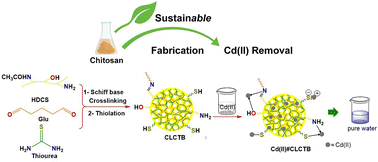
This study presents a facile protocol for fabricating a new sustainable biosorbent, cross-linked thiourea-chitosan thiomer beads (CLCTB), as an eco-friendly scavenger for Cd2+ ions from aqueous effluents. The success of the fabrication protocol was validated, and the molecular and morphological characteristics of the new scavenger were investigated using spectral, thermal, and microscopic analyses. SEM analysis revealed the highly porous nature of the new scavenger, which is favorable for metal ion adsorption. Batch adsorption experiments revealed optimal Cd2+ removal at pH 6, 45 min contact time, 0.5 g adsorbent dose, and ambient temperature (25–30 °C). Kinetic studies showed that the pseudo-second-order model best described the adsorption process, indicating that chemisorption was the dominant mechanism. With a maximum adsorption capacity of 199.69 mg g−1, the Langmuir isotherm provided an optimal fit to the experimental data, proving CLCTB's high adsorption efficiency for Cd. The process was confirmed to be both spontaneous and exothermic through thermodynamic analysis. Additionally, the beads exhibited excellent reusability over six adsorption–desorption cycles, maintaining high performance, which highlights their potential for practical application in water treatment. This study presents CLCTB as a promising, sustainable, and eco-friendly adsorbent for the efficient removal of Cd from contaminated water.
 Please wait while we load your content...


