


 PLATFORM UPDATE:


Biomedical Frontiers with PVA–chitosan/lignin@CdZnO multifunctional hydrogel
 *a
Nadeem Ahmed
Lodhi
e
and
*a
Nadeem Ahmed
Lodhi
e
and
Abstract
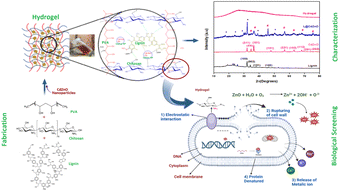
A nanoparticle-based hydrogel was synthesized and evaluated for advanced biomedical applications including antibacterial, anticancer and wound healing functionalities. The hydrogel was fabricated using polyvinyl alcohol (PVA), chitosan and lignin-mediated nanocomposites as the primary components. The resultant nanocomposites and hydrogel were examined using UV-visible spectroscopy, thermal gravimetric analysis, Fourier transform infrared spectroscopy and XRD techniques to confirm their composition and structural integrity. In the context of antibacterial studies, the PVA–chitosan/lignin@CdZnO (PVA-CS/L@CdZnO) hydrogel exhibited superior bactericidal activity compared with CdZnO and L@CdZnO nanocomposites, effectively inhibiting Staphylococcus aureus (S. aureus), Bacillus subtilis (B. subtilis), and Escherichia coli (E. coli). Antioxidant assays showed remarkable efficacy, with 89% of DPPH (2,2-diphenyl-1-picrylhydrazyl) activity and a reducing power absorbance of 0.68. Furthermore, in wound healing studies conducted on a rat model, the hydrogel achieved 91% wound closure within 10 days, significantly surpassing the 61% closure observed in the control group. Furthermore, against MCF-7 breast cancer cell lines, the hydrogel demonstrated 50% anticancer efficacy, showcasing its potential in oncological applications. These results underscore the multifunctional potential of the PVA–CS/L@CdZnO hydrogel, establishing it as an attractive choice for a wide range of biological applications, including antibacterial, antioxidant, anticancer, and wound healing therapies.
 Please wait while we load your content...


