


 PLATFORM UPDATE:


Clay-dye fluorescent hybrid material for the detection of neurotransmitter secretion from cells
 *ab
Ada
De Luigi,
a
Luciano F.
Boesel,
b
Pierre
Picchetti
*c
and
Frank
Biedermann
*c
*ab
Ada
De Luigi,
a
Luciano F.
Boesel,
b
Pierre
Picchetti
*c
and
Frank
Biedermann
*c
Abstract
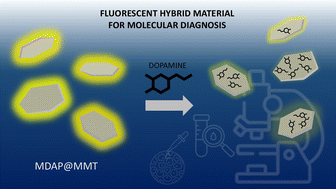
We present a clay-dye hybrid material (MDAP@MMT) for the rapid and selective fluorescence-based detection of catecholamine neurotransmitters. The probe is formed by adsorption of the fluorescent dye 2,7-dimethyldiazapyrenium (MDAP) onto montmorillonite clay (MMT), resulting in partial fluorescence quenching that is further suppressed upon dopamine binding. In aqueous media, the probe responds within one minute and follows a 1 : 1 binding model with dopamine, yielding an average binding constant of Ka = (8.3 ± 1.1) × 104 M−1 and a detection limit of 12 µM. Embedding the probe in agarose hydrogels enhances its stability and enables operation in complex media such as cell culture medium. As proof of concept, the system successfully detected dopamine released from neuroblastoma cells upon stimulation, demonstrating its potential for in vitro neurochemical sensing. The simplicity, responsiveness, and low-cost nature of MDAP@MMT underscore its potential for integration into future sensing platforms aimed at biomedical or diagnostic applications.
 Please wait while we load your content...


