


 PLATFORM UPDATE:


Detection of post-translational modification in a peptide with single-amino acid resolution using a graphyne nanopore: findings from molecular dynamics simulations

Abstract
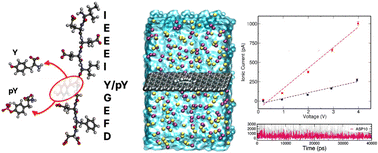
The translocation of molecules through nanopores represents an established technology for molecular identification via their time-dependent ionic current signal. If single-molecule protein sequencing and the identification of post-translational modifications, such as phosphorylation, could be successfully realized with nanopores then this would represent a major breakthrough for applications in the field of life sciences. Toward this goal, we explored the ionic current sensitivity for non-phosphorylated (IEEEIYGEFD) and phosphorylated (IEEEIpYGEFD) forms of the amino acids sequences, using graphyne nanopore. Our study is based on molecular dynamics simulation with a classic force fields description of the system. We find that, from the ionic current, both forms of the peptide can be distinguished through their distinct ionic current traces. The results reveal that a graphyne membrane with an embedded nanopore represents a promising candidate for use in biosensors. Our discoveries on TYR modification and the relationship between ionic current and nanopore area support the viability of graphyne membranes as extremely sensitive nanosensors that can provide unique signatures for various biomolecules.
 Please wait while we load your content...


