


 PLATFORM UPDATE:


Construction of an S-type Fe-doped g-C3N4/MoS2 heterojunction for enhanced charge separation and dual photocatalytic activities
 a
and
a
and
Abstract
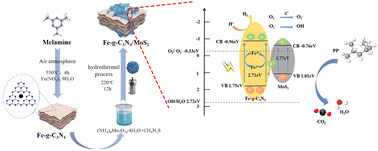
With the continuous increase in plastic consumption, the disposal of polypropylene (PP) fibers has caused severe ecological pollution, highlighting the urgent need for efficient and environmentally friendly degradation technologies. In this study, a novel Fe-doped g-C3N4/MoS2 heterojunction photocatalyst (Fe–g-C3N4/MoS2) was successfully synthesized via a one-pot thermal polymerization combined with a hydrothermal approach, enabling effective component integration and electronic structure modulation. Under visible-light irradiation, the Fe–g-C3N4/MoS2 composite exhibited outstanding photocatalytic performance, achieving a hydrogen evolution rate of 320 μmol g−1 within 4 hours, along with significant degradation capability toward PP fibers. The enhanced performance is primarily attributed to the formation of an S-type heterojunction, which facilitates efficient separation and migration of photogenerated electron–hole pairs, thereby boosting photocatalytic activity. Radical scavenging experiments revealed that photogenerated holes (h+) and hydroxyl radicals (˙OH) played dominant roles in the degradation process, collaboratively promoting the chain scission and mineralization of PP molecules. Furthermore, the catalyst maintained high activity and structural integrity after multiple photocatalytic cycles, demonstrating excellent reusability and practical potential. This work provides a promising and sustainable strategy for mitigating plastic pollution through photocatalytic degradation.
 Please wait while we load your content...


