


 PLATFORM UPDATE:


Pulsed-light-induced photochemical reactions: a case study on trifluoromethylation reactions of 1,3-dimethoxybenzene
 *ac
*ac
Abstract
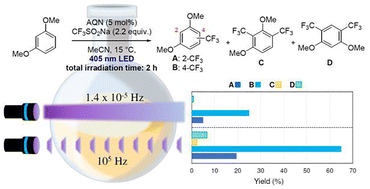
We develop a novel method for controlling photochemical reactions by changing the frequency of pulsed light. A pulsed-light-induced trifluoromethylation reaction is conducted under simple reaction conditions, wherein we combined dimethoxyarene, anthraquinone, and CF3SO2Na in the absence of additives, oxidants, or reductants. Pulsed light yielded more efficient trifluoromethylation reactions than conventional continuous light, while suppressing undesirable reactions. Interestingly, the reaction yield varied with the frequency of pulsed light—ranging from 10−4 Hz to 105 Hz—at the same total irradiation time (7200 s). Our findings suggest that pulsed light offers a promising avenue for controlling photochemical reactions, and beyond traditional parameters like reagents, solution concentration, and temperature, the method of light irradiation emerges as a critical factor in photochemical processes.
 Please wait while we load your content...


