


 PLATFORM UPDATE:


Hemoglobin-loaded ZIF-8 nanoparticles functionalized with human serum albumin as stealth, stable, and biocompatible oxygen carriers
 †a
Arnau
Dieste-Izquierdo,
†a
Clara
Coll-Satue,
a
Eva
Jakljevič,
a
Fernando Enrique
Farfán-Esponda,
a
Ana María
Pablo Sainz-Ezquerra
a
and
Leticia
Hosta-Rigau
*a
†a
Arnau
Dieste-Izquierdo,
†a
Clara
Coll-Satue,
a
Eva
Jakljevič,
a
Fernando Enrique
Farfán-Esponda,
a
Ana María
Pablo Sainz-Ezquerra
a
and
Leticia
Hosta-Rigau
*a
Abstract
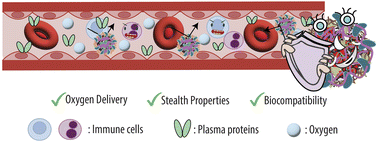
Hemoglobin-based oxygen carriers (HBOCs) offer a promising alternative to transfusions with donor red blood cells (RBCs), particularly in emergency and battlefield settings where blood availability and storage pose significant challenges. However, the clinical translation of HBOCs has been hindered by issues related to structural instability, immune clearance, and impaired hemoglobin (Hb) functionality. To address these limitations, we developed a next-generation HBOC by encapsulating Hb within zeolitic imidazolate framework-8 (ZIF-8) nanoparticles (NPs) (Hb@ZIF-8 NPs) and functionalizing the surface with a covalently bound layer of human serum albumin (HSA)—the most prevalent protein in human plasma. This strategy—employing a poly-L-lysine bridging step and glutaraldehyde crosslinking—resulted in HSA-coated Hb@ZIF-8 NPs with high Hb loading, enhanced colloidal stability in physiologically relevant media, and reduced opsonin adsorption. Compared to PEGylated controls, HSA-coated Hb@ZIF-8 NPs demonstrated superior stealth properties, including minimal IgG binding and preserved dysopsonin (i.e., bovine serum albumin) association. Spectroscopic analyses and oxygen dissociation measurements confirmed that encapsulated Hb retained oxygen-binding and -release capabilities with cooperative behavior. Furthermore, cytotoxicity assays in macrophage cultures revealed improved biocompatibility relative to previously reported ZIF-8-based HBOCs. These findings highlight the potential of HSA-functionalized Hb@ZIF-8 NPs as a safe and effective platform for oxygen delivery, supporting their further development for transfusion medicine and acute care applications.
 Please wait while we load your content...


