


 PLATFORM UPDATE:


Ethylenediamine modified carbon nanospheres from biomass for selective membrane filtration
 d
and
Gurumurthy
Hegde
*ab
d
and
Gurumurthy
Hegde
*ab
Abstract
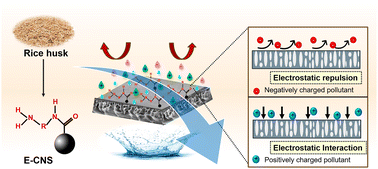
The present work investigates the antifouling properties dye and antibiotic removal efficiency of PVDF/E-CNS membranes. Carbon nanospheres (CNS) derived from rice husk (RH) were pyrolyzed at 800 °C. Further, ethylenediamine functionalized carbon nanospheres (E-CNS) were obtained via in situ decoration of ethylenediamine on acid-functionalized carbon nanospheres (O-CNS). The synthesized E-CNS were characterized by techniques such as XRD, FESEM, Raman spectroscopy, FTIR and BET. The membranes were fabricated by integrating E-CNS at varying loadings (0.1–0.7 wt%) via a non-solvent induced phase separation (NIPS) technique. The membrane properties were assessed through FESEM, water contact angle measurements, pure water flux, antifouling studies and membrane rejections. In comparison to the other developed membranes, PVDF-2 with 0.3 wt% E-CNS loading displayed optimal performance, pure water flux (PWF) of ∼318.90 L m−2 h−1, flux recovery ratio (FRR) > 90% up to three cycles, improved contact angle (80.24° to 68.44°) and reduced roughness. Furthermore, PVDF-2 achieved dye rejection of methyl orange (MO – 93.2%) and rhodamine B (RB – 94.6%), and antibiotic rejection of amoxicillin (AM – 93.8%) and tetracycline (TC – 94.1%), respectively. These findings demonstrate the integration of E-CNS derived from a bio-source, making them a promising additive to improve PVDF membrane performance.
 Please wait while we load your content...


