


 PLATFORM UPDATE:

Cameroonian natural clay derived Linde type LTA zeolite: demystifying and understanding the impact of the synthesis process on adsorption efficiency

Abstract
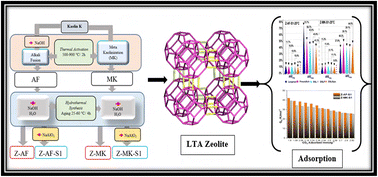
Herein, we reported on two approaches to understanding and demystifying the synthesis process of hierarchical zeolite LTA using cameroonian kaolin. Alkali fusion (AF) and metakaolinization (MK) are two separate techniques, which were used to optimize the synthesis of metakaolin. The derived zeolites were characterized by XRD, XRF, FESEM, FTIR and Raman spectroscopy, NMR, TGA and N2 sorption analysis. Additional NaOH in the mixture of starting materials for the zeolite synthesis increased the relative crystallinity of the product to 92.10% and 94.71%, for both synthesis routes using metakaolin derived by MK and AF, respectively. Crystals with a cubic shape were visible in the SEM images, showing a full zeolitization. Metakaolin produced by AF was found to be most successful in the synthesis of LTA zeolite. CO2 adsorption capacities of 3.96 and 3.53 mmol g−1, were obtained using Z-AF-S1 and Z-MK-S1, respectively. The DSLSips model was found more suitable for the modelling of experimental data compared to DSL, DSLF, Freundlich and Langmuir models. The average isosteric heat of adsorption were 33.13 kJ mol−1 and 30.61 kJ mol−1 for the zeolite samples Z-AF-S1 and Z-MK-S1, respectively. The AF method was found to be a cost-effective and sustainable alternative approach for the production of commercial type 4A zeolite using natural cameroonian kaolin, involving a fast and low-cost chemical process.
- This article is part of the themed collection: Popular Advances
 Please wait while we load your content...


