Issue 24, 2025

Ultrathin millimeter-wave–absorbing film for automotive radars based on an epsilon iron oxide/carbon nanotube composite material

Abstract

Millimeter waves are used in automotive radars to detect surrounding objects such as vehicles and pedestrians. In millimeter-wave automotive radar systems, unnecessary millimeter waves arising from the radar system itself and other radar sources should be suppressed. Herein, we report an ultrathin millimeter-wave–absorbing film for the automotive radar frequency band (79 GHz) based on a composite of gallium-substituted epsilon iron oxide (ε-Ga0.45Fe1.55O3) nanomagnets, which exhibit a high magnetic permeability, and carbon nanotubes (CNTs), which exhibit a high dielectric constant. The composite exhibits a complex dielectric constant (ε = ε′ − ′′) of ε′ = 19.4 and ε′′ = 3.3 and a complex magnetic permeability (μ = μ′ − ′′) of μ′ = 0.87 and μ′′ = 0.13 at 79 GHz. Using this composite, we prepared an ultrathin millimeter-wave–absorbing film which shows a reflection loss of −21.4 dB (99.3% suppression) at 79 GHz with a thickness of 213 ± 8 μm. This ultrathin millimeter-wave–absorbing film can be easily coated on radar device covers, automotive parts such as bumpers, and infrastructure components like guardrails and traffic lights.
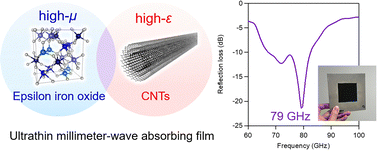
Graphical abstract: Ultrathin millimeter-wave–absorbing film for automotive radars based on an epsilon iron oxide/carbon nanotube composite material

Supplementary files

Article information

Article type
Paper
Submitted
12 Jul 2025
Accepted
28 Oct 2025
First published
05 Nov 2025
This article is Open Access
Creative Commons BY-NC license

Mater. Adv., 2025,6, 9672-9677

Ultrathin millimeter-wave–absorbing film for automotive radars based on an epsilon iron oxide/carbon nanotube composite material

A. Namai, M. Yoshikiyo, J. MacDougall, T. Ono, T. Asai, M. Hara, M. Kanai, T. Yoshida, Y. Miyamoto, K. Sakane, S. Kurahashi, T. Nishio and S. Ohkoshi, Mater. Adv., 2025, 6, 9672 DOI: 10.1039/D5MA00743G

This article is licensed under a Creative Commons Attribution-NonCommercial 3.0 Unported Licence. You can use material from this article in other publications, without requesting further permission from the RSC, provided that the correct acknowledgement is given and it is not used for commercial purposes.

To request permission to reproduce material from this article in a commercial publication, please go to the Copyright Clearance Center request page.

If you are an author contributing to an RSC publication, you do not need to request permission provided correct acknowledgement is given.

If you are the author of this article, you do not need to request permission to reproduce figures and diagrams provided correct acknowledgement is given. If you want to reproduce the whole article in a third-party commercial publication (excluding your thesis/dissertation for which permission is not required) please go to the Copyright Clearance Center request page.

Read more about how to correctly acknowledge RSC content.

Social activity

Spotlight

Advertisements