


 PLATFORM UPDATE:

Dynamic volatile insights of solid-state fermented oats with Lactiplantibacillus plantarum: a future food sustainable development strategy
 a
Biniam
Kebede
*e
a
Biniam
Kebede
*e
Abstract
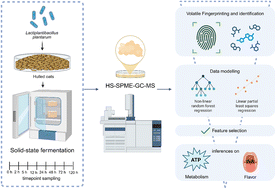
Solid-state fermentation of oats has shown potential for bioactive enrichment and nutritional modification in the quest to develop nutritionally dense foods and meet future global food demands. However, the current body of literature on flavour aspects, such as volatile generation, is lacking. The present study aimed to monitor the volatile evolution of oats fermented using Lactiplantibacillus plantarum as a readily available lactic acid bacterium, followed by a regression analysis of volatile release. Ground, dehulled and stabilised oats were fermented with Lp. plantarum for 0, 2, 5, 12, 24, 48, 72 and 120 hours at 37 °C. Samples were subjected to headspace solid-phase microextraction gas chromatography coupled to mass spectrometry to evaluate volatile changes during fermentation. Aldehydes dominated early samples but decreased rapidly after ∼5 hours of fermentation, while furans and esters decreased to a lesser extent after 48–72 hours. Alcohols and ketones steadily increased until the end of fermentation, as did carboxylic acids and aromatic compounds, while volatile phenols were found to peak at 48 hours of fermentation. In contrast to linear partial least squares regression data modelling, non-linear random forest regression effectively accounted for the non-linear evolution of volatile formations by Lp. plantarum. These results shed light on the metabolic actions of Lp. plantarum and provide insights into the flavour potential of oats via solid-state fermentation while also highlighting the importance of non-linear modelling to predict volatile evolutions accurately.
- This article is part of the themed collections: Emerging Investigators 2025 and Celebrating International Women’s Day 2026: Women in Sustainable Food Technology
 Please wait while we load your content...


