


 PLATFORM UPDATE:


Functionalized asymmetric PVC membrane with molecularly imprinted beads for potentiometric sensing of tetrabromobisphenol A (TBBPA)
 *c
and
Ayman H.
Kamel
*ad
*c
and
Ayman H.
Kamel
*ad
Abstract
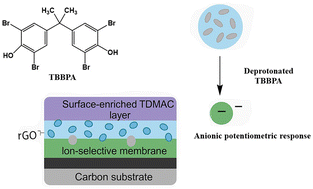
A novel potentiometric sensor based on molecularly imprinted polymer (MIP) beads embedded in an asymmetric membrane configuration was developed for the trace monitoring of tetrabromobisphenol A (TBBPA), a widely used brominated flame retardant and persistent environmental pollutant. The sensor was fabricated by incorporating TBBPA-imprinted beads into a poly(vinyl chloride) (PVC) membrane plasticized with dioctyl phthalate (DOP) and drop-cast onto a reduced graphene oxide (rGO)-modified screen-printed electrode. The asymmetric design featured a surface-enriched ion-exchange layer, enabling enhanced accumulation of deprotonated TBBPA at the membrane interface. Under optimized conditions, the sensor exhibited a near-Nernstian slope of −56.6 ± 1.2 mV per decade over a linear range of 5.0 × 10⁻⁶ to 10−3 M and a detection limit of 5.5 × 10⁻⁷ M. The sensor demonstrated high selectivity toward TBBPA over structurally related phenols and common anions, with the enhanced discrimination attributed to the imprinting effect and nano-scale recognition features. Application to spiked environmental samples including wastewater, sediment, and plastic leachates yielded recoveries between 95.6% and 102.3%, with no significant deviation from high-performance liquid chromatography (HPLC) results (p > 0.05). The proposed MIP-based asymmetric membrane sensor offers a portable, cost-effective, and highly selective platform for on-site environmental monitoring of TBBPA.
 Please wait while we load your content...


