


 PLATFORM UPDATE:


Room temperature capture of hazardous gases by a sustainable N-doped graphene aerogel

Abstract
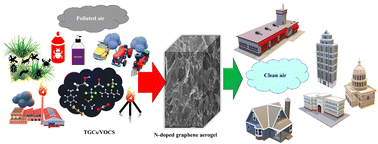
The increasing release of anthropogenic volatile organic compounds (VOCs) and toxic gases (TGCs) has become a key environmental concern. The quest to address the complex capture challenges for VOCs/TGCs removal calls for innovative, advanced, highly efficient and sustainable materials. A straightforward, one-step, low-cost, sustainable and scalable technique was used for the synthesis of a nitrogen-doped graphene aerogel (N-GA) from waste jaggery with a 3D interconnected network, super-hydrophobicity, and a high surface area. The efficiency of waste jaggery derived N-GA as a multifunctional adsorbent for VOCs/TGCs under ambient conditions is investigated in both gaseous and liquid states in a reversible manner. The N-GA realizes the adsorption-based capture of diverse TGCs/VOCs such as dichloromethane (DCM), H2S, CS2, benzene and NH3 with adsorption capacities of over 1226, 1002.07, 885.58, 792.9, and 489.4 mg g−1, respectively, with high regeneration capability over 10 cycles. The feasibility of N-GA for the removal of organics in an aqueous medium has also been investigated for diverse organic solvents. This is relevant to direct application in indoor/outdoor air purification technologies, water remediation and ecosystem protection.
 Please wait while we load your content...


