


 PLATFORM UPDATE:


Does Ce3+ ion doping in CaF2:Tb3+ exhibit more luminescence than CeF3:Tb3+?

Abstract
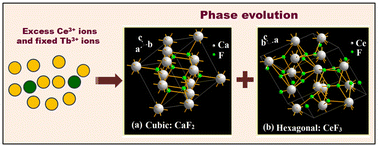
This article reveals the experimental evidence explaining why Tb3+ doping in CaF2:Ce3+ has better luminescence intensity than Tb3+ doping in CeF3. It also discusses the changes in the crystal structure and luminescence when Ce3+ ions are over-doped in CaF2:Tb3+ (Ce3+ = 15–23 at.%; Tb3+ = 5 at.%) nanocrystals. Although both CeF3 and CaF2 as hosts have low phonon vibrations, CaF2 has a larger bandgap than CeF3. Due to this, the luminescence of Ln3+ doped in CaF2 is expected to be better. This has been confirmed by time-resolved luminescence studies, where the decay lifetime of Tb3+ is longer in CaF2:Ce3+–Tb3+ than in CeF3:Tb3+, indicating that CaF2 is a better luminescent host than CeF3. At 15 at% Ce3+ and above, the luminescence intensity of Tb3+ falls as the concentration of Ce3+ ions increases. The energy transfer from Ce3+ to Tb3+ occurs in both the hosts. XRD (X-ray diffraction) and TEM (transmission electron microscopy) analyses confirm the formation of CeF3 (hexagonal) in the case of over-doping of Ce3+ in the CaF2 (cubic) host. The ratio of CaF2 and CeF3 phase concentration decreases with the increase of co-doping of Ce3+. The decay dynamics of Tb3+ ions in CaF2:Ce3+,Tb3+ (Ce3+ = 15–23 at.%; Tb3+ = 5 at.%) nanocrystals are determined, and after careful analysis, the roles of the 2 different host crystals (CaF2 and CeF3) in the decay parameters are observed. The observed luminescence quantum yield (QY) value for Ce3+–Tb3+ doped in the CaF2 host (∼44%) is more than that for Tb3+ doped in the CeF3 host (∼28%).
 Please wait while we load your content...


