


 PLATFORM UPDATE:


Two sites, two stories: sequence-driven divergence in Cu(ii) and Zn(ii) binding to CusF

Abstract
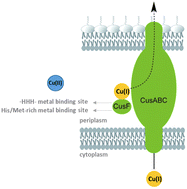
Copper homeostasis is a fine balance for bacteria: essential for respiration, yet toxic in excess. While the CusCFBA efflux system exports Cu(I) from Gram-negative cells, little is known about how its periplasmic chaperone, CusF, might respond to Cu(II) under oxidative stress. This study explored whether CusF's coordination environment is more adaptable than previously assumed, and how histidine spacing influences metal selectivity. We examined two peptides that mimic CusF metal-binding domains: a rare –HHH– motif (Ac-22ANEHHHETMSE32-NH2) and a His/Met-rich binding site (Ac-55TIHHDPIAAVNWPEMTMRFTITPQTKMSE83-NH2). Potentiometry, UV-Vis and CD spectroscopy, ESI-MS, and steady-state fluorescence were used to characterize their Cu(II) and Zn(II) complexes. At physiological pH, both peptides form Cu(II) species with a [1Nim, 2N−] donor set. The –HHH– motif peptide stabilizes these complexes more effectively, likely due to earlier amide engagement enabled by its compact histidine triad. Zn(II) binds to the –HHH– motif peptide through three imidazole donors, whereas the His/Met-rich metal binding site shows higher overall Zn(II) affinity despite involving only two imidazoles. Fluorescence reveals metal-induced perturbations near tryptophan in the Ac-55TIHHDPIAAVNWPEMTMRFTITPQTKMSE83-NH2, with Cu(II) causing stronger quenching and a larger red-shift than Zn(II). Comparison with a calcitermin-derived HxHxH peptide indicates that compact histidine –HHH– clustering better stabilizes Cu(II), whereas spaced histidines favor Zn(II), underscoring how sequence architecture governs metal selectivity.
- This article is part of the themed collections: Celebrating International Women’s Day 2026: Women in Inorganic Chemistry and Dalton Transactions HOT Articles
 Please wait while we load your content...


