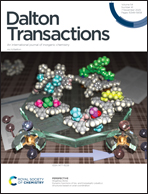
Issue 41, 2025

Lanthanide complexes bearing a bioinspired CuII binding site with picomolar affinity: synthesis, structural, relaxometric and luminescence studies

Abstract

In the pursuit of CuII-responsive MRI contrast agents with enhanced CuII affinity, we report the synthesis and characterization of two LnIII-DO3A-C3AmpicGH complexes (LnIII = GdIII, EuIII), featuring a tetradentate CuII-binding moiety, along with the corresponding mononuclear CuII-C3AmpicGH complex. The chelator coordinates CuII through two amide groups, a pyridine and an imidazole ring. The use of a propyl-amide linker between the LnIII- and CuII-binding moieties allowed an increased separation between the two metal centers. As a result, both LnIII–CuII-DO3A-C3AmpicGH and CuII-C3AmpicGH complexes exhibit the same CuII-affinity (log K = 11–12 at pH 7.4) and good selectivity over competing physiological metal ions, particularly ZnII (up to at least 500 equivalents). While the GdIII complex displayed no relaxivity changes upon CuII binding, the EuIII analogue showed a luminescence turn-off response. Spectroscopic analyses as well as density functional theory (DFT) calculations provide insights into the coordination environments of both metal ions, notably confirming the absence of amide coordination to the LnIII center, even in absence of CuII.

Graphical abstract: Lanthanide complexes bearing a bioinspired CuII binding site with picomolar affinity: synthesis, structural, relaxometric and luminescence studies

Supplementary files

Transparent peer review

To support increased transparency, we offer authors the option to publish the peer review history alongside their article.

View this article’s peer review history

Article information

Article type
Paper
Submitted
23 Jul 2025
Accepted
22 Sep 2025
First published
29 Sep 2025
This article is Open Access
Creative Commons BY-NC license

Dalton Trans., 2025,54, 15432-15440

Lanthanide complexes bearing a bioinspired CuII binding site with picomolar affinity: synthesis, structural, relaxometric and luminescence studies

K. Zimmeter, B. Vileno, A. Pallier, C. Platas-Iglesias, P. Faller, C. S. Bonnet and A. Sour, Dalton Trans., 2025, 54, 15432 DOI: 10.1039/D5DT01735A

This article is licensed under a Creative Commons Attribution-NonCommercial 3.0 Unported Licence. You can use material from this article in other publications, without requesting further permission from the RSC, provided that the correct acknowledgement is given and it is not used for commercial purposes.

To request permission to reproduce material from this article in a commercial publication, please go to the Copyright Clearance Center request page.

If you are an author contributing to an RSC publication, you do not need to request permission provided correct acknowledgement is given.

If you are the author of this article, you do not need to request permission to reproduce figures and diagrams provided correct acknowledgement is given. If you want to reproduce the whole article in a third-party commercial publication (excluding your thesis/dissertation for which permission is not required) please go to the Copyright Clearance Center request page.

Read more about how to correctly acknowledge RSC content.

Social activity

Spotlight

Advertisements