


 PLATFORM UPDATE:

Atomistic catalytic reaction networks: case study on electrochemical reduction of CO, NO & combinations
 *a
and
Amy
Wuttke
a
*a
and
Amy
Wuttke
a
Abstract
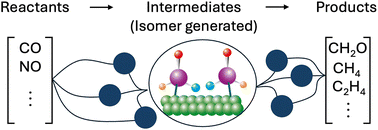
Establishing reaction paths for heterogeneous catalysis reactions on surfaces by calculating key reaction intermediates from educated guesses has enabled the researcher to derive free energy diagrams and develop mechanistic models for small molecules with limited reaction steps. For reactions with multiple products, reactants, or a large number of reaction steps, proposing and validating a reaction mechanism is extremely challenging, if not impossible. In this work, we propose the use of isomer generators as a tool to generate atomistic reaction networks on catalytic surfaces. We showcase how this tool can be used to carry out exhaustive exploration of reaction paths and generate all products which the reactants can form. From here we count generated intermediates and products arising from multiple CO, NO and combination of reactants, depicting logarithmic scale of complexity in a reaction network of multiple reactants with a large number of reaction steps. We then test a 2CO network on a Cu(111) surface via density functional theory (DFT) simulations to show the difference between educated guesses and automatically generated intermediates. The idea of using molecular isomer generators allows the complete and automatized exploration of complex surface catalytic mechanisms beyond educated guesses.
 Please wait while we load your content...


