


 PLATFORM UPDATE:


Effect of Er doping on the In2O3(001) surface for H2S, NO2, and CO detection: a DFT study

Abstract
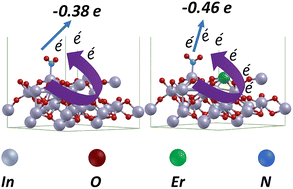
The impact of Erbium (Er) doping on the gas sensing performance of the In2O3(001) surface toward H2S, NO2, and CO was rigorously investigated using density functional theory (DFT) calculations. Analysis based on adsorption energy, Bader charge transfer, and density of states (DOS) confirms that Er doping selectively enhances the surface reactivity toward NO2. Key results demonstrate a marked improvement in NO2 binding strength: the adsorption energy increases significantly from −0.37 eV on the pristine surface to −0.61 eV on the Er-doped surface. This stronger chemisorption is supported by enhanced electron withdrawal from the surface by NO2, with the charge transfer increasing from −0.38 e (pristine) to −0.46 e (Er-doped). Furthermore, TDOS and PDOS analyses confirm the appearance of new, strong electronic states near the Fermi level only after NO2 adsorption on the doped surface, indicating robust electron coupling. Conversely, Er doping weakens the interaction with the other test gases. For H2S, the adsorption energy reduces from −0.53 eV to −0.42 eV, and charge transfer drops sharply from +0.40 e to +0.09 e. CO adsorption remains weak, with the energy decreasing slightly from −0.25 eV to −0.19 eV. These findings indicate that Er-doped In2O3(001) surfaces exhibit enhanced selectivity, making them highly promising candidates for selective NO2 detection.
- This article is part of the themed collection: Celebrating International Women’s day 2026: Women in physical chemistry
 Please wait while we load your content...


