


 PLATFORM UPDATE:


Prediction of electronic, magnetic, and structural stability characteristics in Al- and Ga-doped single-walled SiC nanotubes: ab initio study using DFT
 *a
Sevda
Rzayeva,
a
Khayala Ajdar
Hasanova,
ab
Ionut Cristian
Scurtu,
e
Octavian Narcis
Volintiru
e
*a
Sevda
Rzayeva,
a
Khayala Ajdar
Hasanova,
ab
Ionut Cristian
Scurtu,
e
Octavian Narcis
Volintiru
e
Abstract
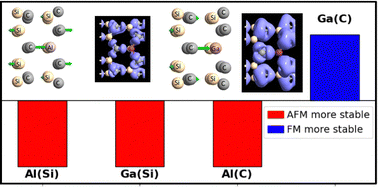
We investigate the effects of Al- and Ga-defects on the electronic, magnetic, and structural stability of single-walled (6,0) SiC nanotubes (SWSiCNTs) through density functional theory simulations. Our results show that doping at either Si or C sites dramatically alters electronic behavior: Al doping at the Si site yields half-metallic behavior at 8.3% concentration (spin-up band gap ∼1.40 eV; spin-down channel metallic), while double doping (16.6%) yields full metallicity in both spin channels. Ga doping at the Si site shows semiconducting gaps for both spins at lower doping (8.3%), but transitions toward half-metallicity at higher doping (16.6%) with the spin-down channel becoming metallic. Doping at the C site preserves semiconducting behavior in both spin channels but introduces strong spin asymmetry: e.g. for Al doping at C, band gaps drop to ∼0.66 eV (spin-up) and ∼0.51 eV (spin-down) at 8.3%; for Ga at C, gaps reduce to ∼0.44 eV/0.60 eV at 8.3% and ∼0.26 eV at 16.6% for both spins. Partial density of states (PDOS) analyses reveal that near-Fermi states are dominated by carbon p orbitals and dopant d orbitals. Magnetic moment calculations show total magnetic moments around 1.0µB for single dopants, with much larger moments (∼8.5µB) for double Al dopants at C sites, and ∼6.0µB for double Ga at C. Both Al- and Ga-doped SWSiCNTs prefer antiferromagnetic ground states when substituted at Si sites, whereas Ga doping at C sites favors a ferromagnetic configuration. Stability assessments including geometry optimization, stress tensor and force analysis, and ab initio molecular dynamics demonstrate that all studied configurations are thermodynamically stable; however, Al-doped tubes generally show superior kinetic and mechanical stability, with lower residual forces, smaller stress tensor norms, and more modest thermal fluctuations during AIMD. Phonon band structure calculations further confirm the dynamical stability of all Al- and Ga-doped (6,0) SiCNT systems, as no imaginary frequencies were observed across the Brillouin zone, verifying that the optimized configurations are mechanically and vibrationally stable. These findings suggest that tuned doping (type, site, concentration) in SiC nanotubes can achieve desirable half-metallicity and robust magnetic behavior, positioning Al- and Ga-doped (6,0) SWSiCNTs as strong candidates for spintronic applications.
- This article is part of the themed collection: Celebrating International Women’s day 2026: Women in physical chemistry
 Please wait while we load your content...


