


 PLATFORM UPDATE:


From molecular geometry to combustion kinetic model application: ab initio calculations of reaction kinetics between diethyl ether radicals and O2
 b
Chong-Wen
Zhou
*ad
b
Chong-Wen
Zhou
*ad
Abstract
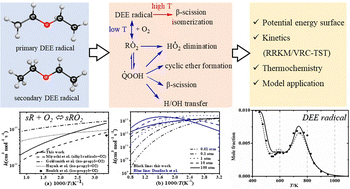
Diethyl ether (DEE) is an oxygenated biofuel with a high cetane number. Its blending with diesel not only improves the combustion performance at low temperatures, but also reduces pollutant emissions. This work aims to investigate the detailed kinetics of DEE radical combustion oxidation by O2 molecules and its unimolecular decomposition. It further elucidates the implications of the computational kinetics and thermochemical data obtained herein for DEE combustion kinetic models. High-level ab initio calculations for all species were performed at the QCISD(T)/CBS//M06-2X/6-311++G(d,p) level of theory. Conventional transition state theory (CTST) was employed for reactions with tight transition states. Variable reaction coordinate transition state theory (VRC-TST) was used to calculate the rate constants for the barrierless reaction channel. The multi-reference complete active space second-order perturbation theory CASPT2(7e,5o)/cc-pVDZ was used in the VRC-TST sampling calculations and coupled with one-dimensional geometry and basis set corrections to describe the radical–radical recombination interaction along the bond formation process. The Rice–Ramsperger–Kassel–Marcus/master equation was employed to calculate the temperature- and pressure-dependent rate constants for all the reaction channels investigated. The results indicate that the formation of diethyl ether peroxy radicals (RȮ2) dominates under high pressures and low temperatures and that the first O2 addition to a secondary DEE radical (sRȮ2) is more reactive than that to a primary radical site (pRȮ2). The isomerization of sRȮ2 to ![[Q with combining dot above]](https://www.rsc.org/images/entities/char_0051_0307.gif) OOH via a 1,5 H-transfer dominates below 900 K. C–O β bond fission and cyclic ether formation are major pathways for OOH consumption. C2H5OĊ2H4-2 ⇌ CH3CHO + C2H5 is the most favored reaction channel for DEE radical decomposition. The computed rate constants and thermochemical data in this work were incorporated into the latest DEE mechanism to investigate their influence on the model predictions. The simulated results show that the updated mechanism predicts increased ignition delay times at temperatures below 800 K. Additionally, the updated mechanism was also used to simulate mole fraction profiles of reaction intermediates at 106.7 kPa with equivalence ratio φ = 1 over the temperature range of 400–1100 K. This study provides valuable insights into the effects of key reaction classes on diethyl ether (DEE) fuel combustion at low temperatures and contributes an essential theoretical foundation for a more comprehensive understanding of DEE's low-temperature combustion mechanisms.
OOH via a 1,5 H-transfer dominates below 900 K. C–O β bond fission and cyclic ether formation are major pathways for OOH consumption. C2H5OĊ2H4-2 ⇌ CH3CHO + C2H5 is the most favored reaction channel for DEE radical decomposition. The computed rate constants and thermochemical data in this work were incorporated into the latest DEE mechanism to investigate their influence on the model predictions. The simulated results show that the updated mechanism predicts increased ignition delay times at temperatures below 800 K. Additionally, the updated mechanism was also used to simulate mole fraction profiles of reaction intermediates at 106.7 kPa with equivalence ratio φ = 1 over the temperature range of 400–1100 K. This study provides valuable insights into the effects of key reaction classes on diethyl ether (DEE) fuel combustion at low temperatures and contributes an essential theoretical foundation for a more comprehensive understanding of DEE's low-temperature combustion mechanisms.
 Please wait while we load your content...


