Issue 42, 2025

Predicting pesticide vapour pressures: the power of functional groups

Abstract

Explainable machine learning can aid in deriving chemical rules, which in combination with inverse molecular design methods, can support humans to optimise classes of molecules such as pesticides. This study demonstrates that pesticide vapour pressures can be predicted (77.1% and 83.3% within one order of magnitude) using kernel ridge regression (krr) and XGBoost on quantum chemical molecular properties but these models lack easy interpretability. However, insights (via Shapley additive explanations (SHAP)) can be gained when a framework of functional groups is employed instead. Functional group-based models (krr: 66.7% within one order of magnitude) reveal that aromatic compounds, sulfonic acid derivatives, and carboxylic acid derivatives influence the vapour pressure the most. SHAP value trends indicate a linear relationship between reduced vapour pressure and the frequency of functional groups. A provided list of functional group contributions enables molecular modifications to optimise pesticide vapour pressures.
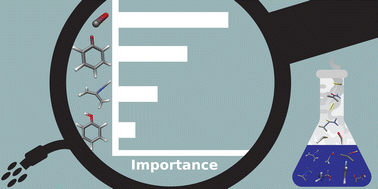
Graphical abstract: Predicting pesticide vapour pressures: the power of functional groups

Supplementary files

Transparent peer review

To support increased transparency, we offer authors the option to publish the peer review history alongside their article.

View this article’s peer review history

Article information

Article type
Paper
Submitted
24 May 2025
Accepted
30 Sep 2025
First published
01 Oct 2025

Phys. Chem. Chem. Phys., 2025,27, 22820-22830

Predicting pesticide vapour pressures: the power of functional groups

M. Heezen, M. Alcamí, C. Rauer and F. De Vleeschouwer, Phys. Chem. Chem. Phys., 2025, 27, 22820 DOI: 10.1039/D5CP01965F

To request permission to reproduce material from this article, please go to the Copyright Clearance Center request page.

If you are an author contributing to an RSC publication, you do not need to request permission provided correct acknowledgement is given.

If you are the author of this article, you do not need to request permission to reproduce figures and diagrams provided correct acknowledgement is given. If you want to reproduce the whole article in a third-party publication (excluding your thesis/dissertation for which permission is not required) please go to the Copyright Clearance Center request page.

Read more about how to correctly acknowledge RSC content.

Social activity

Spotlight

Advertisements