


 PLATFORM UPDATE:

Theoretical study on the selective adsorption of SF6/N2 by covalent triazine frameworks

Abstract
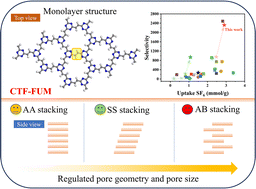
Under the impetus of dual-carbon goals, it is of great significance to achieve sustainable utilization of SF6, a greenhouse gas with significant industrial value. In this study, four covalent triazine frameworks (CTFs) with three 2D stacking modes (AA, AB, and SS) were selected to investigate their effects on SF6/N2 adsorption and separation performance. All the frameworks contain abundant nitrogen heteroatoms with pore sizes smaller than 9 Å. The results show that CTF-FUM-SS has an optimal pore size and exhibits the highest adsorption performance, with a selectivity of 2321.738 at 1 bar for SF6/N2. Grand Canonical Monte Carlo (GCMC) simulations reveal that the staircase-like stacking (SS) has the best selective adsorption of SF6/N2 because of its more appropriate pore size range. Although the iso-directional interlayer slipping leads to a minor decrease in porosity, pore volume, and surface area between SS and AA structures, SS-stacked CTFs exhibit higher SF6 adsorption capacity compared to their AA-stacked counterparts. Notably, the closer the pore size of the CTF is to the kinetic diameter of SF6, the more pronounced is the difference in selectivity between SS and AA structures. Adsorption snapshots, charge density difference (CDD) analysis, and independent gradient model based on Hirshfeld partition (IGMH) analysis have also been used to investigate the adsorption mechanism. The research shows that adjusting the pore shape is beneficial for strengthening the adsorption sites and accelerating the saturation of SF6 at 0.1–1 bar, thereby increasing the adsorption capacity. These findings are expected to deepen the understanding of structure–performance relationships in covalent organic frameworks (COFs) for gas separation and broaden their potential applications in energy and environmental science.
 Please wait while we load your content...


