


 PLATFORM UPDATE:


Acid protonation promoted different crystal phase structure silicon carbide-based carbon nitride composites to enhance the photocatalytic degradation of dye wastewater
 †*ab
Enke
Feng,
a
†*ab
Enke
Feng,
a
Abstract
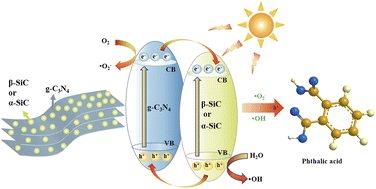
Acid-protonated crystalline silicon carbide-supported carbon nitride photocatalytic composites were successfully prepared by the impregnation-heat treatment method (P-g-C3N4/β-SiC and P-g-C3N4/α-SiC). The samples were characterized by X-ray diffraction (XRD), scanning electron microscopy (SEM), transmission electron microscopy (TEM), X-ray photoelectron spectroscopy (XPS), Fourier transform infrared (FT-IR), UV-vis diffuse reflectance spectra (UV-vis-DRS) photoluminescence (PL), etc. The results of SEM showed that the P-g-C3N4/β-SiC and P-g-C3N4/α-SiC materials were transformed from large-area lamellar structures to uniform and dispersed lamellar particles. The UV-vis-DRS and PL showed that the recombination probability of photogenerated electron–hole pairs of P-g-C3N4/β-SiC and P-g-C3N4/α-SiC samples decreased and the band gap increased. The results of photocatalytic degradation of alizarin red S (ARS), acid fuchsin (AF), and basic fuchsin (BF) showed that the samples P-g-C3N4/β-SiC and P-g-C3N4/α-SiC had excellent photocatalytic degradation performance. It is worth noting that the degradation performance of the sample P-g-C3N4/β-SiC on the three dyes is better than that of P-g-C3N4/α-SiC. The electron spin resonance spectra (ESR) results showed that the ˙O2− and ˙OH produced by the two catalysts during the dye degradation process played a leading role in the degradation reaction. Fortunately, the catalyst maintains an excellent cycle life and can be reused more than seven times while degrading all three dyes.
 Please wait while we load your content...


