


 PLATFORM UPDATE:


Cuboidal liquid crystal phases under multiaxial geometrical frustration
 a
Julio C.
Armas-Pérez,
b
Juan P.
Hernández-Ortiz
*acg
and
Juan J.
de Pablo
*af
a
Julio C.
Armas-Pérez,
b
Juan P.
Hernández-Ortiz
*acg
and
Juan J.
de Pablo
*af
Abstract
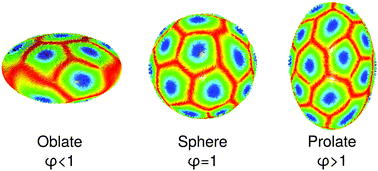
Cuboidal liquid crystal phases – the so-called blue phases – consist of a network of topological defects arranged into a cubic symmetry. They exhibit striking optical properties, including Bragg reflection in the visible range and fast response times. Confining surfaces can interfere with the packing of such a network, leading to structures that have not been explored before. In this work, a Landau–de Gennes free energy formalism for the tensor alignment field Q is used to investigate the behavior of chiral liquid crystals under non-isotropic confinement. The underlying free energy functional is solved by relying on a Monte Carlo method that facilitates efficient exploration of configuration space. The results of simulations are expressed in terms of phase diagrams as a function of chirality and temperature for three families of spheroids: oblate, spherical, and prolate. Upon deformation, blue phases adapt and transform to accommodate the geometrical constraints, thereby resulting in a wider range of thermal stability. For oblate spheroids, confinement interferes with the development of a full blue phase structure, resulting on a combination of half skyrmions. For prolate spheroids, the blue phases are hybridized and exhibit features of blue phases I and II. More generally, it is shown that mechanical deformation provides an effective means to control, manipulate and stabilize blue phases and cholesterics confined in tactoids.
 Please wait while we load your content...


