


 PLATFORM UPDATE:

Interchange between coordinated and lattice solvents generates the highest energy barrier within nine-coordinated DyIII single molecule magnets†
 *a
Wenyuan
Wang,
a
*a
Wenyuan
Wang,
a
Abstract
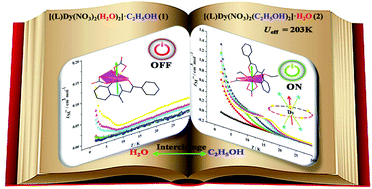
It is crucial to promote axiality to enhance easy-axis magnetic anisotropy. Two mononuclear DyIII compounds, in which each DyIII is nine-coordinated, namely, [(C12H10N5O)Dy(NO3)2(H2O)2]·C2H5OH (1) and [(C12H10N5O)Dy(NO3)2(C2H5OH)2]·H2O (2) (HL = N3-(2-pyridoyl)-4-pyridinecarboxamidrazone), have been prepared through controlling the amount of C2H5OH and H2O solvents. Geometry modulations were realized by interchanging coordinated and lattice solvents, thus achieving a structure closer to the configuration of a capped square antiprism for 2 compared to that for 1. Notably, magnetic studies revealed that compound 1 displays no slow relaxation of magnetization while compound 2 exhibits single-molecule magnet (SMM) behaviour in the absence of a static magnetic field, with the highest energy barrier (203.11 K) of nine-coordinated DyIII SMMs. Ab initio calculations were performed to elucidate such a distinct performance, demonstrating that the combination of the larger charge distribution along the magnetic axis and the lower charge distribution in the equatorial plane generates a strong easy-axis ligand field to enhance magnetic properties, which is further associated with the structural symmetry. In addition, a possible coordination mode is proposed to realize high axis anisotropy for nine-coordinated DyIII compounds. This work presents an effective method to modulate the dynamic magnetic relaxation of the DyIII SMMs through interchange between coordinated and lattice solvents.
 Please wait while we load your content...


