


 PLATFORM UPDATE:

Theoretical modeling of valence tautomeric dinuclear cobalt complexes. Adducts of CoII diketonates with cyclic redox-active tetraone ligands†
Abstract
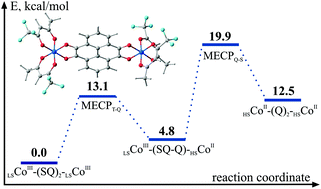
The approach to the employment of the mechanism of valence tautomerism (VT) for the design of molecular 2-qubit quantum gates has been extended to adducts 5–8 of CoII bis-(malonates), bis-(acetylacetonates), bis-(hexafluoroacetylacetonates) and bis-(trifluoroacetylacetonates) with tetradentate tetraone (cyclic di-o-quinones) redox-active piperazine-2,3,5,6-tetraone L5 (X = NH), 3,3,6,6-tetramethylcyclohexane-1,2,4,5-tetraone L5 (X = C(CH3)2), cyclopenta[fg]acenaphthylene-1,2,5,6-tetraone L6, cyclopenta[fg]acenaphthylene-3,4,7,8-tetraone L7 and pyrene-4,5,9,10-tetraone L8 and computationally studied using the B3LYP*/6-311++G(d,p) method. The calculations reveal ferromagnetic ordering of unpaired electrons in the low-spin electromeric forms of complexes 8 (R1, R2 = H, CH3, CF3) on the basis of L8, which provides for the paramagnetic character of all three interconverting electromers of 8 and makes it possible to realize the two-step mechanism of thermally driven migration of paramagnetic centers between the pyrene-tetraone fragment and metal ions. Through the structural variation of the ancillary diketonate ligands the energy gaps between the electromeric forms of adducts 8 and energy barriers for their interconversion were adjusted to the range of values typical of thermal VT rearrangements. The best energy parameters for the occurrence of thermal two-step VT rearrangements involving all three paramagnetic electromeric forms can be achieved for complex 8 (R1 = CH3, R2 = CF3), which was shown to meet the principal conditions for compounds with a potential role of spin qubit carriers: thermal stability with respect to dissociation into the components, thermally accessible energy barriers for the interconversion of the electromers and weak coupling between their paramagnetic centers.
 Please wait while we load your content...


