


 PLATFORM UPDATE:


Highly photoactive SnO2 nanostructures engineered by electrochemically active biofilm†
Abstract
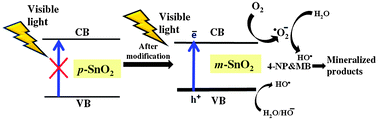
This paper reports the defect-induced band gap narrowing of pure SnO2 nanostructures (p-SnO2) using an electrochemically active biofilm (EAB). The proposed approach is biogenic, simple and green. The systematic characterization of the modified SnO2 nanostructures (m-SnO2) revealed EAB-mediated defects in the pure SnO2 nanostructures (p-SnO2). The modified SnO2 (m-SnO2) nanostructures in visible light showed the enhanced photocatalytic degradation of p-nitrophenol and methylene blue compared to the p-SnO2 nanostructures. The photoelectrochemical studies, such as the electrochemical impedance spectroscopy and linear scan voltammetry, also revealed a significant increase in the visible light response of the m-SnO2 compared to the p-SnO2 nanostructures. The enhanced activities of the m-SnO2 in visible light was attributed to the high separation efficiency of the photoinduced electron–hole pairs due to surface defects mediated by an EAB, resulting in a band gap narrowing of the m-SnO2 nanostructures. The tuned band gap of the m-SnO2 nanostructures enables the harvesting of visible light to exploit the properties of the metal oxide towards photodegradation, which can in turn be used for environmental remediation applications.
 Please wait while we load your content...


