


Quantum vibrational spectroscopy with classical trajectories

Abstract
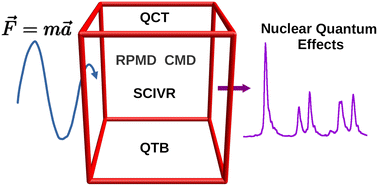
Vibrational spectroscopy is a technique of wide use in fields like analytical chemistry, biomedical applications, and pharmacology. The technique is cost-effective and very popular. However, a reliable assignment of vibrational spectra may be hard to achieve for large molecular systems or when nuclear quantum effects (NQEs) are sizeable. These aspects hamper the effectiveness of vibrational spectroscopy as an analytical and characterization tool. Computational approaches may help overcome the shortcomings of a purely experimental investigation. For instance, classical molecular dynamics is computationally cheap and easy to perform by a non-expert user as well, but it cannot account for NQEs. The latter can be included in an affordable way if approximate quantum mechanical methods based on classical trajectories are employed. Herein, we review the main theoretical approaches based on classical trajectories and able to deal with NQEs in vibrational spectroscopy. We start by reporting on the possibility to employ methods derived from the path integral representation of quantum mechanics, i.e. semiclassical (SC) dynamics, centroid molecular dynamics (CMD), ring polymer molecular dynamics (RPMD), and their variants. Then, other techniques like the quantum thermal bath (QTB) and the quasi-classical trajectory (QCT) method are highlighted. All but SC methods are based on a fully classical real-time propagation. This review aims at increasing the awareness of useful and ready-to-use classical-trajectory-based computational techniques among the broader community of experimental researchers, developers, and applied scientists, who employ vibrational spectroscopy in their everyday activity.
- This article is part of the themed collections: 2026 Chemical Science Perspective & Review Collection and 15th anniversary: Chemical Science community collection
 Please wait while we load your content...


