


 PLATFORM UPDATE:


Mechanistic insights and catalyst design for the selective hydrogenolysis of cellulose to C2–C3 alcohols
 *b
Yanqiang
Huang
b
*b
Yanqiang
Huang
b
Abstract
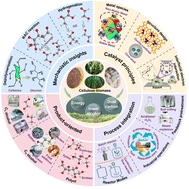
Catalytic hydrogenolysis of cellulose into low-carbon alcohols offers a promising route toward sustainable chemical manufacture and carbon-neutral energy systems. Recent advances in aqueous-phase catalysis have progressively clarified the reaction network encompassing cellulose depolymerization, glucose isomerization, retro-aldol C–C scission, and the hydrogenation of key carbonyl intermediates. This review integrates these mechanistic insights with catalyst and process design, highlighting how noble-metal and non-noble bifunctional systems leverage acid–metal cooperation, redox flexibility, and spatial confinement to orchestrate glycosidic, C–O, and C–C bond activation with increasing precision. Kinetic and engineering studies further reveal how reactor configuration, operating conditions, and feedstock pretreatment shape conversion efficiency and carbon utilization in both batch and continuous modes. Emerging opportunities, including single-atom catalysts that maximize atom efficiency and enable precise site control, defect-engineered oxides, machine-learning-assisted discovery for accelerated catalyst optimization, and integrated reaction-separation platforms, hold considerable promise for enabling cost-effective, scalable, and recyclable catalytic systems. Together, these advances establish a coherent framework linking fundamental chemistry with reactor-level engineering, laying the groundwork for practical one-step aqueous-phase routes to bio-derived low-carbon alcohols.
- This article is part of the themed collection: #MyFirstChemSci 2026
 Please wait while we load your content...


