


Carrageenan grafted with acrylic acid and sulfonamide induces apoptosis and suppresses proliferation in A549 lung cancer cells: synthesis, cytotoxicity, gene expression, and in silico studies

Abstract
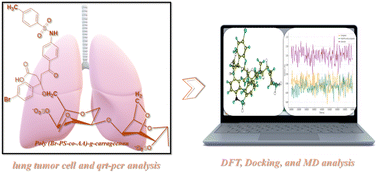
This study was aimed at developing an effective, low-cost, safe, and selective anticancer agent through a free radical-triggered grafting copolymerization process of carrageenan with acrylic acid (AA) and sulfonamide derivative (Br-PS) in good yield. The resulting product, poly(Br-PS-co-AA)-g-carrageenan, was subjected to energy dispersive X-ray (EDX) spectroscopy, scanning electron microscopy (SEM), thermal gravimetric (TG) analysis, and Fourier-transform infrared (FT-IR) spectroscopy for its characterization. Compared with doxorubicin (IC50 = 16.1 µg/mL; SI = 9.1), poly(Br-PS-co-AA)-g-carrageenan exhibited a stronger growth inhibition and higher selectivity against A549 cells with IC50 = 12.3 µg/mL and SI = 11.7 after 48 hours, as assessed by the neutral red uptake assay. Meanwhile, gene expression analysis revealed that treatment with poly(Br-PS-co-AA)-g-carrageenan decreased the expression levels of C-myc and Cyclin D1 while elevating P21 levels in A549 cells, thereby suppressing cell proliferation and promoting apoptosis. Furthermore, the electronic and structural properties of poly(Br-PS-co-AA)-g-carrageenan were validated through density functional theory (DFT) calculations. Molecular docking and dynamic simulations demonstrated a potent affinity for binding to important cancer-related targets, such as EGFR, C-myc, and P21, with stable conformational dynamics. The study concludes that poly(Br-PS-co-AA)-g-carrageenan is a safe, effective, and promising option for treating lung cancer that merits more preclinical research.
 Please wait while we load your content...


