


 PLATFORM UPDATE:

Isolation and characterization of bioactive constituents from Withania coagulans Dunal with antioxidant and multifunctional enzyme inhibition potential, supported by docking, MD, and DFT studies

Abstract
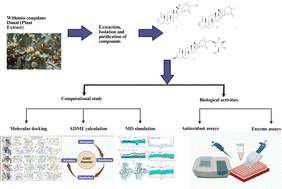
Withania coagulans Dunal is a medicinal plant with potential therapeutic applications in neurodegenerative and metabolic disorders. This study aimed to isolate, structurally characterize, and evaluate the biological potential of withanolide-type compounds from Withania coagulans Dunal, with a focus on their antioxidant and enzyme inhibitory activities relevant to neurodegenerative and metabolic disorders. Two new withanolides (WTH1 and WTH2) and one known compound (WTH3) were isolated from W. coagulans. The methanol extract and its fractions were assessed for total phenolic and flavonoid contents, antioxidant capacity (DPPH, FRAP, phosphomolybdenum assays), and enzyme inhibitory activities against acetylcholinesterase (AChE), butyrylcholinesterase (BChE), lipoxygenase, α-glucosidase, and tyrosinase. The methanol extract exhibited the highest total phenolic (71.53 mg GAE per g) and flavonoid (64.32 mg QE per g) contents, correlating with strong antioxidant activity (DPPH: 91.2%, FRAP: 678.3 µmol Fe2+ per g, phosphomolybdenum: 4.2 mmol TE per g). It showed significant inhibitory effects against AChE (4.10 mg GALAE per g), BChE (3.71 mg GALAE per g), lipoxygenase, α-glucosidase, and tyrosinase, with the ethyl acetate fraction displaying the strongest α-glucosidase inhibition (3.51 mmol ACAE per g). In silico docking revealed strong binding affinities of WTH1 and WTH3 toward AChE (−11.616 and −11.438 kcal mol−1, respectively), while WTH3 also interacted effectively with BChE (−9.30 kcal mol−1), surpassing the standard drug physostigmine (−5.85 kcal mol−1). Pharmacokinetic evaluation of WTH1 predicted high gastrointestinal absorption (97.65%), moderate oral bioavailability (0.55), and absence of hepatotoxicity or AMES toxicity. DFT analysis indicated a stable HOMO–LUMO energy gap (9.923 eV), and binding free energy calculations confirmed strong interaction of WTH1 with AChE using PB (−29.731 kcal mol−1) and GB (−43.54 kcal mol−1) methods, outperforming the reference drug (−15.08 kcal mol−1). The findings demonstrate that W. coagulans methanol extract, particularly the isolated new withanolide WTH1, exhibits potent antioxidant and enzyme inhibitory activities with promising pharmacokinetic properties. These results support further pharmacological and clinical evaluation of W. coagulans as a natural source of therapeutic agents against neurodegenerative and metabolic disorders.
 Please wait while we load your content...


