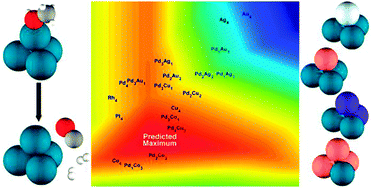
A combination of first principles Density Functional Theory calculations and thermochemical scaling relationships are employed to estimate the thermochemistry and kinetics of methanol decomposition on unsupported subnanometer metal clusters. The approach uses binding energies of various atomic and molecular species, determined on the pure metal clusters, to develop scaling relationships that are then further used to estimate the methanol decomposition thermodynamics for a series of pure and bimetallic clusters with four atoms per cluster. Additionally, activation energy barriers are estimated from Brønsted–Evans–Polanyi plots relating transition and final state energies on these clusters. The energetic results are combined with a simple, microkinetically-inspired rate expression to estimate reaction rates as a function of important catalytic descriptors, including the carbon and atomic oxygen binding energies to the clusters. Based on these analyses, several alloy clusters are identified as promising candidates for the methanol decomposition reaction.
You have access to this article
 Please wait while we load your content...
Something went wrong. Try again?
Please wait while we load your content...
Something went wrong. Try again?