This website uses cookies to give you the best user experience. If you continue
without changing your settings we'll assume you are happy to receive all RSC cookies.
You can change your cookie settings by navigating to our Privacy and Cookies page and following the instructions. These instructions
are also obtainable from the privacy link at the bottom of any RSC page.
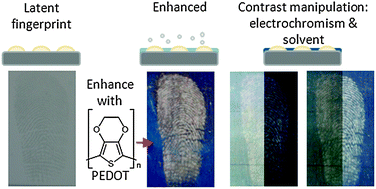
Spatially selective electrodeposition of poly-3,4-ethylenedioxythiophene (PEDOT) thin films on metallic surfaces is shown to be an effective means of visualizing latent fingerprints. The technique exploits the fingerprint deposit as an insulating mask, such that electrochemical processes (here, polymer deposition) may only take place on deposit-free areas of the surface between the ridges of the fingerprint deposit; the end result is a negative image of the fingermark. Use of a surfactant (sodium dodecylsulphate, SDS) to solubilise the EDOT monomer allows the use of an aqueous electrolyte. Electrochemical (coulometric) data provide a total assay of deposited material, yielding spatially averaged film thicknesses, which are commensurate with substantive filling of the trenches between fingerprint deposit ridges, but not overfilling to the extent that the ridge detail is covered. This is confirmed by optical microscopy and AFM images, which show continuous polymer deposition within the trenches and good definition at the ridge edges. Stainless steel substrates treated in this manner and transferred to background electrolyte (aqueous sulphuric acid) showed enhanced fingerprints when the contrast between the polymer background and fingerprint deposit was optimised using the electrochromic properties of the PEDOT films. The facility of the method to reveal fingerprints of various ages and subjected to plausible environmental histories was demonstrated. Comparison of this enhancement methodology with commonly used fingerprint enhancement methods (dusting with powder, application of wet powder suspensions and cyanoacrylate fuming) showed promising performance in selected scenarios of practical interest.
Fetching data from CrossRef. This may take some time to load.
Physical Chemistry Chemical Physics
- Information Point