This website uses cookies to give you the best user experience. If you continue
without changing your settings we'll assume you are happy to receive all RSC cookies.
You can change your cookie settings by navigating to our Privacy and Cookies page and following the instructions. These instructions
are also obtainable from the privacy link at the bottom of any RSC page.
College of Polymer Science and Engineering, State Key Laboratory of Polymer Materials Engineering, Sichuan University, Chengdu 610065, China
E-mail: hongtan@scu.edu.cn
; Fax: +86-28-85405402
; Tel: +86-28-85460961
Soft Matter, 2012,8, 5414-5428
DOI:
10.1039/C2SM07402H
Received
17 Dec 2011,
Accepted
01 Feb 2012
First published online
01 Mar 2012
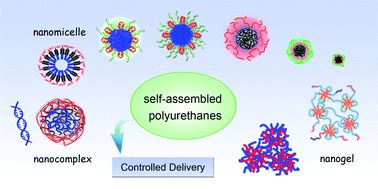
The self-assembly of biodegradable polyurethanes constitutes an important area of research for the development of polymeric materials in biomedicine. In particular, colloidal polyurethane assemblies can increase the solubility and stability of hydrophobic compounds, and improve the specificity and efficiency of drug action. Their nanoscale size and modular functionality make them promising for the injectable, targeted and controlled delivery of various therapeutic agents and imaging probes into required cells. Additionally, cationic polyurethanes are able to self-assemble with nucleic acids into nanoparticles to enter cells for efficient gene transfection. These emerging nanocarriers open the door for addressing the failure of traditional localized delivery systems, and present a compelling future opportunity to achieve personalized therapy as versatile candidates. This review article highlights the research progress in the self-assembly of biodegradable polyurethanes for controlled delivery applications, with particular attention being paid to some representative vehicles such as self-assembled polyurethane micelles, nanogels, and polyurethane/DNA complexes, which have emerged as the focus of interest in recent years.
Fetching data from CrossRef. This may take some time to load.