This website uses cookies to give you the best user experience. If you continue
without changing your settings we'll assume you are happy to receive all RSC cookies.
You can change your cookie settings by navigating to our Privacy and Cookies page and following the instructions. These instructions
are also obtainable from the privacy link at the bottom of any RSC page.
Department of Nanobiotechnology, Institute of Nanobiology and Structural Biology of GCRC AS CR, Na Sadkach 7, 370 05 Ceske Budejovice, Czech Republic
E-mail: ivosaf@yahoo.com
; Fax: +420 38636 1279
; Tel: +420 38777 5608
b
Regional Centre of Advanced Technologies and Materials, Palacky University, Slechtitelu 11, 783 71 Olomouc, Czech Republic
E-mail: ivosaf@yahoo.com
; Tel: +420 38777 5608
c
Department of Biochemistry, Faculty of Science, Palacky University, Slechtitelu 11, 783 71 Olomouc, Czech Republic
E-mail: kristyna.pospiskova@seznam.cz
; Fax: +420 58563 4933
; Tel: +420 58563 4928
Soft Matter, 2012,8, 5407-5413
DOI:
10.1039/C2SM06861C
Received
29 Sep 2011,
Accepted
22 Dec 2011
First published online
15 Mar 2012
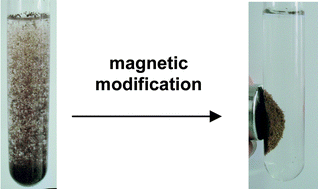
Different types of biological materials are available for an enormous amount of bioscience, biotechnology and environmental technology applications. These materials are mainly diamagnetic, which means they do not interact significantly with an external magnetic field. However, several procedures can be used to convert biological materials into magnetically responsive composite materials which can be efficiently separated using simple magnets or magnetic separation systems. The prepared magnetic biocomposites can be used for many applications, such as magnetic removal and separation of xenobiotics and biologically active compounds, immobilization of target compounds, as parts of biosensors or as whole cell biocatalysts.
Fetching data from CrossRef. This may take some time to load.