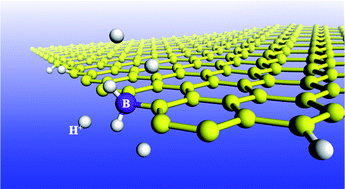
The practical number of charge carriers loaded is crucial to the evaluation of the capacity performance of carbon-based electrodes in service, and cannot be easily addressed experimentally. In this paper, we report a density functional theory study of charge carrier adsorption onto zigzag edge-shaped graphene nanoribbons (ZGNRs), both pristine and incorporating edge substitution with boron, nitrogen or oxygen atoms. All edge substitutions are found to be energetically favorable, especially in oxidized environments. The maximal loading of protons onto the substituted ZGNR edges obeys a rule of [8-n-1], where n is the number of valence electrons of the edge-site atom constituting the adsorption site. Hence, a maximum charge loading is achieved with boron substitution. This result correlates in a transparent manner with the electronic structure characteristics of the edge atom. The boron edge atom, characterized by the most empty p band, facilitates more than the other substitutional cases the accommodation of valence electrons transferred from the ribbon, induced by adsorption of protons. This result not only further confirms the possibility of enhancing charge storage performance of carbon-based electrochemical devices through chemical functionalization but also, more importantly, provides the physical rationale for further design strategies.
You have access to this article
 Please wait while we load your content...
Something went wrong. Try again?
Please wait while we load your content...
Something went wrong. Try again?


 SCHEDULED MAINTENANCE