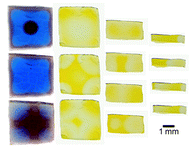
Polymeric hydrogels that exhibit autonomous, coupled chemical and mechanical oscillations are a unique example of synthetic, active soft matter. Here, we explore the effects of gel aspect ratio and absolute dimensions on pattern formation in hydrogels undergoing the Belousov-Zhabotinsky (BZ) reaction. We synthesize and analyze N-isopropylacrylamide gels containing covalently bound BZ catalyst and polyacrylamide-silica gel composites containing physically associated BZ catalyst. Through both experiments and computational simulations, we demonstrate that the oscillating chemical patterns within BZ gels can be altered by changing the shape and size of the gel, and that these patterns evolve over long timescales. In our simulations, we utilize an improved Oregonator model, which explicitly accounts for the total concentration of the catalyst grafted onto the polymer network. We find that the three-dimensional simulations of the BZ gels successfully reproduce patterns, oscillation periodicity, and catalyst concentration-dependence observed in experiments. Together, these findings validate our theoretical and computational approaches for modeling chemomechanical coupling in active, chemo-responsive gels, and enable future studies that exploit the shape- and size-confinement effects of self-oscillating reactions.
You have access to this article
 Please wait while we load your content...
Something went wrong. Try again?
Please wait while we load your content...
Something went wrong. Try again?