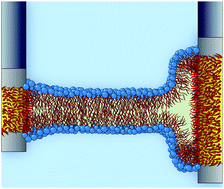
The ability to non-destructively integrate inorganic structures into or through biological membranes is essential to realizing full bio-inorganic integration, including arrayed on-chip patch-clamps, drug delivery, and biosensors. Here we explore the role of nanoscale patterning on the strength of biomembrane–inorganic interfaces. AFM measurements show that inorganic probes functionalized with hydrophobic bands with thicknesses complimentary to the hydrophobic lipid bilayer core exhibit strong attachment in the bilayer. As hydrophobic band thickness increases to 2–3 times the bilayer core the interfacial strength decreases, comparable to homogeneously hydrophobic probes. Analytical calculations and molecular dynamics simulations predict a transition between a ‘fused’ interface and a ‘T-junction’ that matches the experimental results, showing lipid disorder and defect formation for thicker bands. These results show that matching biological length scales leads to more intimate bio-inorganic junctions, enabling rational design of non-destructive membrane interfaces.
You have access to this article
 Please wait while we load your content...
Something went wrong. Try again?
Please wait while we load your content...
Something went wrong. Try again?