Vimal K. Jain
New J. Chem., 2019,43, 11034-11040
DOI:
10.1039/C9NJ02769F,
Perspective


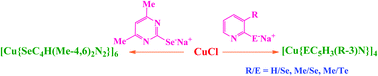
2-/4-Pyridyl chalcogenolates (S, Se and Te) and 2-(4,6-dimethyl)pyrimidyl selenolate complexes of coinage metals (Cu, Ag and Au), with and without phosphine ligands, such as [Cu(Epy)]4 (E = Se or Te), [Cu(Sepym)]6, [Ag2(μ-Spy)2(PPh3)4], [Ag3(μ-Sepy)3(PPh3)4] and [Ag(EAr)]6, [Au(SeAr)(PR3)], etc., have been synthesised and characterized unambiguously by single crystal X-ray diffraction analyses. The silver phosphine complexes undergo phosphine dissociation in solution to yield a variety of complexes, [Ag2(μ-Spy)2(PPh3)4], [Ag3(μ-Sepy)3(PPh3)4] and [Ag(Epy)]6. These complexes, depending on the nature of the ligands, exhibit metallophilic interactions in the solid state. Thermolysis of copper and silver complexes in coordinating solvents yields metal selenide nano-crystals. AACVD of [Cu(EpyMe)]4 (E = Se or Te) has been used to deposit continuous and uniform films of Cu5Se4 and Cu1.85Te on a glass substrate. The copper complexes in combination with an appropriate indium or tin precursor have also been used for the preparation of phase pure ternary compounds like CuInSe2 and Cu2SnSe3.