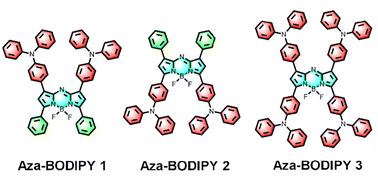
In this study, a series of boron-azadipyrromethene (aza-BODIPY) dyes 1–3 bearing two or four triphenylamine (TPA) units at the 1,7- and/or 3,5-positions of their azadipyrromethene core were synthesized. The structures and properties of these dyes were investigated in detail by X-ray crystallographic analysis, cyclic voltammetry, UV/Vis absorption and emission spectroscopy, TGA, and DFT calculations. All the aza-BODIPYs 1–3 exhibited intensive NIR absorption with wavelengths up to 900 nm. Meanwhile, fluorescence with wavelengths up to 1100 nm and quantum yields ranging from 6.5% to 20.9% were observed for these dyes. Moreover, aza-BODIPY 1 exhibited an optimal energy alignment with the valence band of the perovskite and the highest hole mobility (4.6 × 10⁻⁴ cm2 V−1 s−1) among the dyes, leading to the best performance of the perovskite solar cells (PSCs) based on 1 with a power conversion efficiency (PCE) of 18.12% as compared with the devices based on 2 and 3. Furthermore, IPCE spectra underscored the contribution of the NIR absorption of these dyes to the overall photocurrent of the devices, indicating that introducing multiple electron-donating TPA units into the electron-accepting aza-BODIPY core was an effective strategy for the development of new dopant-free HTMs for PSCs with NIR light harvesting capabilities.