


Unveiling the distinct effect mechanisms of H2O: aggravating and mitigating SO2 poisoning of Fe2O3 and α-MnO2 catalysts in low-temperature NH3-SCR
 *abd
and
Jinsheng
Chen
abd
*abd
and
Jinsheng
Chen
abd
Abstract
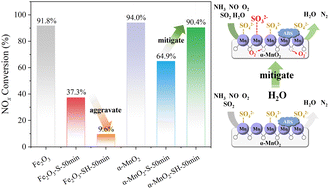
Elucidating the mechanisms of coexisting SO2 and H2O, especially H2O's dual function in aggravating or mitigating SO2 poisoning pathways, is pivotal for the rational design of high-performance, poison-resistant low-temperature SCR catalysts. This study compared the tolerance, sulfur-containing species, and reactive oxygen species of Fe2O3 and α-MnO2 chosen as model catalysts in SO2 alone versus a combined SO2 and H2O atmosphere, and unveils the distinct effect mechanisms of H2O on Fe2O3 and α-MnO2. That is, H2O aggravates SO2 poisoning on Fe2O3 while H2O mitigates SO2 poisoning on the α-MnO2 catalyst in the SCR reaction at 150–250 °C. After 50 min of poison exposure at 200 °C, the NOx conversion of α-MnO2 decreased from 94.0% to ∼64.9% with SO2, whereas it remained high at 90.4% upon co-exposure to SO2 and H2O. The dominant sulfur-containing species formed are verified as ABS on Fe2O3 and MnSO4 on α-MnO2, respectively. H2O exacerbates SO2 poisoning on Fe2O3via competitive adsorption against reactants. However, H2O mitigates SO2 poisoning of α-MnO2 complexly by suppressing SO2 oxidation to form more sulfites and simultaneously activating surface lattice oxygen by protons from H2O dissociation, which generates abundant oxygen vacancies for converting O2 into reactive oxygen species. H2O exclusively activates lattice oxygen on α-MnO2, attributable to its higher surface lattice oxygen mobility than Fe2O3. This study reveals the intrinsic mechanism of the dual roles of H2O in SCR catalysts, providing new design strategies for developing low-temperature NH3-SCR catalysts with enhanced resistance to H2O and SO2 poisoning.
- This article is part of the themed collection: Advances in Sustainable Catalysis: from Materials to Energy and Environmental Applications
 Please wait while we load your content...


