


Beyond molecular mastery: reimagining chemistry education for sustainability through knower-aware pedagogy
 *a
and
Lausanne
Olvitt
b
*a
and
Lausanne
Olvitt
b
Abstract
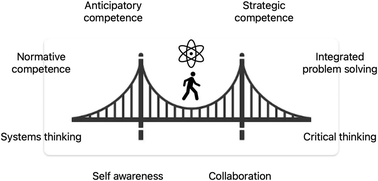
This paper argues that chemistry education for sustainability requires explicit attention to the person of the chemist and the contexts in which chemical knowledge is produced and applied. We term this a ‘knower-aware pedagogy’. We begin by introducing UNESCO's sustainability competences and highlight the centrality of the education of the particular person in a particular context. We then show the ways in which chemistry education has tended to focus on knowledge and has a tendency towards ‘knower blindness’. We proceed to illustrate one way in which a knower-aware pedagogy can be developed. Using the metaphor of the suspension bridge, we demonstrate that transformative chemistry education requires not only robust disciplinary knowledge and understanding of the nature of chemistry, but also development of evaluative judgment and explicit recognition of the learner as the agent. We conclude with a comprehensive self-assessment tool enabling instructors to evaluate whether their courses develop the sustainability competences essential for preparing ethical, socially responsible chemistry practitioners capable of contributing to global sustainability transitions.
- This article is part of the themed collection: Chemical Education for Global Sustainability
 Please wait while we load your content...


