


A transfer learning framework integrating molecular dynamics and group contribution methods for predicting polymer specific heat capacity

Abstract
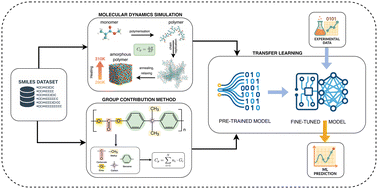
Heat capacity (Cp) of polymers is an essential property for diverse applications, such as energy storage systems, electronics thermal management, and thermal insulation. In this study, we explore a transfer learning framework to predict polymer Cp, where models are first pretrained on large datasets generated from molecular dynamics (MD) simulations and group contribution (GC) calculations, and then fine-tuned using experimental data. We evaluate multiple machine learning (ML) models, including multilayer perceptrons and graph neural networks, using various molecular fingerprints and structural descriptors. The trained models are applied to existing polymers and virtual polymers to enable large-scale Cp prediction and screening. We analyze structure–property relationships to identify key molecular features influencing Cp and propose an updated GC model through a data-driven regression for quick Cp evaluation. Using the predicted Cp, in combination with thermal conductivity and glass transition temperature, we search polymers for four functional categories relevant to thermal applications: thermal interface materials, insulators, buffers, and heat spreaders. Representative polymer candidates are identified for each category based on the combined thermal property thresholds, demonstrating the practical relevance of predicted values for real-world material selection. This integrated approach enables targeted selection of polymer materials for specific thermal applications.
- This article is part of the themed collections: Polymer Chemistry Open Access Spotlight 2026 and Data Science and Machine Learning in Polymer Research
 Please wait while we load your content...


