


Are there specific sub-classes of halogen bonds? A statistical analysis of the interactions in crystal structures†

Abstract
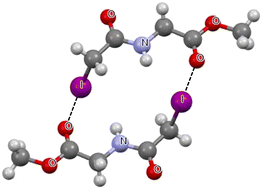
Different sub-classes of so-called halogen bonds are analysed, i.e. fluorine, chlorine, bromine and iodine bonds. These interactions are compared with analogous hydrogen bonds. For this purpose, Cambridge Structural Database (CSD) searches were performed to find specific structures where systems linked by C–X⋯O and C–X⋯N interactions occur (X is a halogen centre). Besides, CSD searches were carried out to find the corresponding structures with C–H⋯O and C–H⋯N interactions. These types of halogen bonds and two types of hydrogen bonds are compared with the use of statistical approaches. The X⋯O/N and H⋯O/N bond distances as well as the C–X⋯O/N and C–H⋯O/N bond angles are also compared. Four complex samples analysed theoretically (MP2/6-311++G(d,p) calculations were performed) in an earlier study, which are linked by I–I⋯N, N![[triple bond, length as m-dash]](https://www.rsc.org/images/entities/char_e002.gif) C–I⋯N, Br–Br⋯N and NC–Br⋯N interactions, are also considered in this study. For these theoretical results, two parameters are analysed statistically: the binding energy and electron density at the I⋯N or Br⋯N bond critical points. It is also noted in this study that the names applied commonly for various types of interactions so far can be replaced by other more informative names.
C–I⋯N, Br–Br⋯N and NC–Br⋯N interactions, are also considered in this study. For these theoretical results, two parameters are analysed statistically: the binding energy and electron density at the I⋯N or Br⋯N bond critical points. It is also noted in this study that the names applied commonly for various types of interactions so far can be replaced by other more informative names.
- This article is part of the themed collection: Celebration of the 70th birthday of Prof. Giuseppe Resnati
 Please wait while we load your content...


