DOI:
10.1039/D5NJ03549J
(Communication)
New J. Chem., 2025,
49, 18683-18687
Carbon-dot-supported small molecule dyes as a light-harvesting platform for cell imaging†
Received
3rd September 2025
, Accepted 4th October 2025
First published on 8th October 2025
Abstract
Constructing an aqueous-phase light-harvesting scaffold with simple fabrication and excellent biocompatibility is of significant importance. Herein, blue-emitting carbon dots (BCDs), characterized by their unique core structure and abundant shell defects, were developed as a light-harvesting scaffold. An efficient artificial light-harvesting platform (ESY@BCDs) was constructed by co-assembling eosin Y (ESY), a commercial dye, exhibiting an ultrahigh energy-transfer efficiency (95%). Additionally, this CD-based light-harvesting platform was utilized for cell imaging successfully as the first example, to the best of our knowledge. This work could serve as a new versatile platform to construct aqueous-phase light-harvesting platforms for cell imaging.
Introduction
Natural photosynthesis is a complex biochemical process which harvests, transfers, and then converts solar energy into chemical energy.1–4 To mimic the energy harvesting and transmission process, designing and constructing aqueous-phase light-harvesting platforms (LHPs) have attracted widespread research focus in recent years.5–11 For instance, Liu's group employed cyclodextrin-based supramolecular assemblies as efficient light-harvesting donors in 2017.12 Li's team engineered tunable, thermos-responsive liquid crystals with high antenna effects in 2022,13 while Yang et al. developed difluoroboron chromophore-inspired nanocrystals exhibiting ultrahigh energy transfer efficiency at minimal donor concentrations in 2016.14 In addition, Stoddart, Liu and their coworkers created a photo regulatable system with carbon quantum dots for broad-spectrum white-light-tunable emission in 2019.15 Most recently, Han and Xing have established an artificial LHP that achieves efficient three-step energy transfer, controllable switching between type I and type II photochemistry, and highly efficient photocatalytic Minisci reaction in the aqueous phase with 91% yield.16 Meanwhile, our group has successively developed a series of artificial LHPs, which have been applied in fields such as photocatalysis,17 WLED devices,18 and photochemical sensing.19,20 However, most of the light-harvesting scaffolds are predominantly confined to organic molecular systems,21–24 which exhibit relatively poor biocompatibility and are infrequently employed in the field of bioimaging. Consequently, there is an urgent need to develop green, stable, and biocompatible light-harvesting scaffolds to better align with the requirements of sustainable production and to mitigate environmental pollution.
Carbon dots (CDs) have recently emerged as attractive carbon nanoparticles,25–29 showcasing excellent properties characteristic of both carbon materials and inorganic/organic semiconductors.30–32 The unique electronic structure of the carbon core endows CDs with characteristics conducive to both electron and energy transfer,33 positioning them as promising candidates for biomimetic natural LHP.34–37 However, most currently reported CD energy transfer systems rely on the covalent attachment of CDs to small molecules through amide or coupling reactions etc.38–40 In contrast, supramolecular assembly via non-covalent interactions provides a more straightforward and potentially more biocompatible strategy. Notably, the inherent scaffold properties of CDs,41 which arise from the strong noncovalent interactions between the abundant functional groups in their shell structure and small molecules, are often overlooked to some degree. Therefore, the development of CD-based LHP through supramolecular interactions holds significant promise.
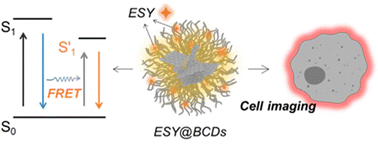
Herein, an LHP has been successfully constructed by blue-emitting CDs (BCDs) with small molecule dye eosin Y (ESY) (Scheme 1). This system benefits from the unique core–shell structure and abundant shell defects of BCDs, and multiple noncovalent interactions between BCDs and ESY, such as hydrogen-bonding interactions and π-stacking interactions, which could promote the Förster resonance energy transfer (FRET) process.42,43 Ultimately, owing to the superior water solubility and biocompatibility of BCDs, we utilized this LHP for cell imaging, resulting in a synergistic outcome that combines the excellent biocompatibility of CDs with the outstanding photoluminescence (PL) properties of the dyes. This work could serve as a valuable example for the advancement of CD-based LHPs.
 |
| | Scheme 1 The constructed process of ESY@BCDs. (a) The core–shell structure of BCDs, highlighting the dominance of energy transfer in the core and the role of the molecular scaffold in the shell. (b) The photophysical process and cell imaging associated with ESY@BCDs. | |
Results and discussion
BCDs were fabricated through solvent-free pyrolysis of mixtures of citric acid (CA) with benzoylurea (BU) by our group's previous method (Scheme 2).44 It is evident that BCDs exhibit a round-like morphology, uniform dispersion, and consistent size through transmission electron microscopy (TEM) (Fig. 1(a)), with an average dimension of ∼5.2 nm (Fig. 1(b)). Powder X-ray diffraction (PXRD) results indicate that BCDs are predominantly amorphous; however, pronounced diffraction peaks near 26° correspond to the crystal plane at (002) of a graphene-like crystal structure (Fig. 1(c)).45–47 This observation aligns with the 0.21 nm crystal planar spacing identified in high-resolution TEM (inset in Fig. 1(a)), suggesting that BCDs possess a distinct core–shell structure,48 wherein the carbon core is crystalline and the polymer shell is amorphous. Furthermore, this amorphous shell structure provides numerous loading sites, and distinct characteristic peaks indicative of defects can be observed through Raman spectroscopy (Fig. 1(d)).49,50 The unique core–shell architecture and the presence of abundant shell defects confer significant potential for BCDs to serve as a scaffold for small molecule dyes.
 |
| | Scheme 2 The process of constructing BCDs through solvent-free reaction of CA and BU. | |
 |
| | Fig. 1 (a) TEM image of BCDs (inset: HRTEM of BCDs). (b) The corresponding size distribution of BCDs. (c) XRD spectrum of BCDs. (d) Raman spectrum of BCDs. | |
The optical properties of BCDs in aqueous solution were also examined. As illustrated in Fig. S1, the BCDs exhibit a broad absorption range of 310 to 500 nm, with a characteristic absorption wavelength of ∼340 nm. Consistent with expectations, the aqueous solution of BCDs exhibited bright blue photoluminescence under 365 nm irradiation. This property, along with the unique core–shell structure of the BCDs, which provides binding sites for small molecules through noncovalent interaction, enabled the successful construction of an LHP in water using the commercially available dye ESY. We initially measured the absorption of ESY and emission spectra of BCDs to explore the FRET process between the BCDs and ESY. As shown in Fig. 2(a), the absorption spectrum of ESY shows a good overlap with the emission spectrum of the BCDs, which could ensure a highly efficient FRET between the donor BCDs and acceptor ESY. We then prepared ESY@BCDs assemblies by the dropwise addition of varying volumes (20–400 μL) of an aqueous ESY solution (2 mM) to an aqueous solution of BCDs (100 μg mL−1). The final concentration of ESY in the assemblies ranged from 20 to 400 μM (see SI for details). Upon increasing the ESY content in the BCDs, the fluorescence intensity of the BCDs at 420 nm significantly decreased when excited at 365 nm, whereas the emission of ESY at 556 nm enhanced (Fig. 2(b) and Fig. S2), proving the FRET from the donor BCDs to the acceptor ESY. Moreover, an obvious fluorescence color change from blue to yellow could be observed with the naked eye (Fig. 2(b) inset and Fig. S3). Besides, to further explore the energy-transfer process between BCDs and ESY, the fluorescence lifetimes of the BCDs were investigated. As shown in Fig. 2(c), the lifetimes at 420 nm were reduced slightly from 1.25 ns to 0.90 ns after adding acceptor ESY, confirming the FRET process. To evaluate the performance of the ESY@BCD system quantitatively, we then calculated the energy-transfer efficiency (ΦET). The LHP showed gradually enhanced ΦET with increasing ESY acceptor content. As expected, the ΦET is calculated to be up to 95% when the addition volume of ESY is 400 μL (cESY = 400 μM) (Fig. 2(d)), which is higher than most of the LHP with ESY in the same conditions,51–54 demonstrating a highly efficient energy-transfer between the BCDs and ESY. While the PL quantum yield at this moment was measured to be 7.71% (Table S1).
 |
| | Fig. 2 (a) Normalized emission spectra of the BCDs (blue lines) and normalized absorption spectra of ESY (yellow lines). (b) Fluorescence spectra of the ESY@BCDs with different addition volumes of ESY (0–400 μL). λex = 365 nm; inset: photographs of the BCDs and ESY@BCDs under UV light, [BCDs] = 50 μg mL−1. (c) The time-resolved photoluminescence decay spectra at 420 nm of BCDs before and after adding ESY (400 μL). (d) The energy transfer efficiency in the LHP with increasing ESY acceptor content. | |
Notably, a probable energy transfer mechanism of this system was proposed (Fig. 3(a)). When the LHP was excited at the optimal absorbance wavelength of 365 nm for donor BCDs, a FRET process could occur spontaneously through a donor–acceptor recognition route. This process involved the transfer of a portion of energy from the excited state of the BCDs to the ground state of ESY, leading to the enhanced emission of the ESY at 556 nm. Then, the luminescence color change of the LHP during the energy transfer process can be read directly from the CIE 1931 chromaticity diagram.55,56 In Fig. 3(b), it can be seen that the luminescence color of the BCDs is located in the blue area. With the content of ESY increasing in the range from 0 to 400 μL, the color of the LHP gradually changed from blue to yellow.
 |
| | Fig. 3 (a) Proposed mechanism of the FRET process. (b) The CIE 1931 chromaticity diagram of the BCDs with increasing volume of ESY (0–400 μL), [BCDs] = 50 μg mL−1. | |
To the best of our knowledge, CD-based LHPs have rarely been utilized for bioimaging. Since the ESY@BCD system has good biocompatibility, cell imaging experiments were performed. As demonstrated in previous work,44 BCDs can successfully enter the cytoplasm within 20 min for cell staining (Fig. 4(a)); however, the staining effect is suboptimal. Simultaneously, valuable fluorescence signals within the cells are challenging to identify effectively when ESY is co-incubated with cells for 20 min (Fig. 4(c)). But things changed in the ESY@BCDs, and notable improvement was observed in the experimental group where the assembled ESY@BCDs were co-incubated with cells.
 |
| | Fig. 4 Confocal fluorescence images of live HepG2 cells. PL image of HepG2 cells incubated with (a) BCDs (50 μg mL−1), (b) ESY@BCDs (50 μg mL−1, 2 mM), and (c) ESY (2 mM) for 20 min at 37 °C. The images were acquired upon excitation at 405 nm and PL emission was collected at 410–500 nm and 550–700 nm. Scale bar = 20 μm. | |
As illustrated in Fig. 4(b), the ESY@BCDs emitted fluorescence signals within the range of 410–500 nm under 405 nm excitation, resulting in a uniform blue fluorescence across the cells. But the intensity of this fluorescence was reduced in comparison to that of the BCDs alone, aligning with the steady-state spectral data.
Furthermore, considering FRET, we collected fluorescence signals in the 550–700 nm range without altering the excitation wavelength and intensity. This analysis revealed a bright fluorescence signal from the assembled ESY@BCDs, demonstrating that upon cellular entry, the assembly not only maintains structural stability but also facilitates the FRET process effectively. Therefore, as molecular dye scaffolds, the BCDs efficiently combined payload delivery with energy transfer, providing valuable insights for enhanced cell imaging.
Conclusions
In summary, we successfully constructed a CD-based LHP that leverages the excellent scaffold performance of BCDs derived from a unique core–shell structure, which can support a substantial amount of small molecule dye ESY through noncovalent interaction. Simultaneously, the core structure effectively facilitates energy transfer to ESY through the FRET process, achieving an energy transfer efficiency of up to 95%. Moreover, continuously tunable emission colors from blue to yellow could be easily realized. More importantly, this payload and energy transfer mechanism adeptly addresses the limitations associated with the poor cell imaging effectiveness of BCDs and the challenges of imaging ESY alone, significantly enhancing the effect of cell imaging. This work not only provides theoretical support for the development of CD-based light-harvesting scaffolds but also introduces innovative ideas for improving the quality of cell imaging.
Author contributions
Z. Wang conceived the study; K. Diao and F. Shan supervised the experiment; X. Liu and C. Liao performed the preparation, analysis, characterization, and bioimaging studies. F. Shan, K. Diao, and W. Wang analyzed the data and wrote the draft manuscript with input from all authors. Z. Wang and L. Wang provided important suggestions and revised the manuscript. All authors discussed the results and commented on the manuscript.
Conflicts of interest
There are no conflicts to declare.
Data availability
The data that support the findings of this study are available from the corresponding author, L. Wang or Z. Wang, upon reasonable request.
Supplementary information (SI) is available. See DOI: https://doi.org/10.1039/d5nj03549j.
Acknowledgements
This work was financially supported by the Sichuan Science and Technology Program (2023NSFSC1977 and 2022ZYD0048), National Training Program of Innovation and Entrepreneurship for Undergraduates (No. 202310623017), and Training Program of Innovation and Entrepreneurship for Undergraduates, Xihua University (No. xhb2024062).
References
- J. Huh, S. K. Saikin, J. C. Brookes, S. Valleau, T. Fujita and A. Aspuru Guzik, J. Am. Chem. Soc., 2014, 136, 2048–2057 CrossRef CAS PubMed.
- A. Melis, Energy Environ. Sci., 2012, 5, 5531–5539 RSC.
- X. Qin, M. Suga, T. Kuang and J. R. Shen, Science, 2015, 348, 989–995 CrossRef CAS PubMed.
- G. D. Scholes, G. R. Fleming, A. Olaya Castro and R. van Grondelle, Nat. Chem., 2011, 3, 763–774 CrossRef CAS PubMed.
- Q. Song, S. Goia, J. Yang, S. C. L. Hall, M. Staniforth, V. G. Stavros and S. Perrier, J. Am. Chem. Soc., 2020, 143, 382–389 CrossRef PubMed.
- X. M. Chen, Q. Cao, H. K. Bisoyi, M. Wang, H. Yang and Q. Li, Angew. Chem., Int. Ed., 2020, 59, 10493–10497 CrossRef CAS PubMed.
- S. Guo, Y. Song, Y. He, X. Y. Hu and L. Wang, Angew. Chem., Int. Ed., 2018, 57, 3163–3167 CrossRef CAS PubMed.
- K. Wang, Y. Shen, P. Jeyakkumar, Y. Zhang, L. Chu, R. Zhang and X. Y. Hu, Curr. Opin. Green Sustainable Chem., 2023, 41, 100823 CrossRef CAS.
- D. Zhang, W. Yu, S. Li, Y. Xia, X. Li, Y. Li and T. Yi, J. Am. Chem. Soc., 2021, 143, 1313–1317 CrossRef CAS PubMed.
- Q. Zhang, X. Dang, F. Cui and T. Xiao, Chem. Commun., 2024, 60, 10064–10079 RSC.
- D. Chen, T. Xiao, É. Monflier and L. Wang, Commun. Chem., 2024, 7, 88 CrossRef CAS PubMed.
- J. J. Li, Y. Chen, J. Yu, N. Cheng and Y. Liu, Adv. Mater., 2017, 29, 1701905 CrossRef.
- Z. Yu, H. K. Bisoyi, X. M. Chen, Z. Z. Nie, M. Wang, H. Yang and Q. Li, Angew. Chem., Int. Ed., 2022, 61, e202200466 CrossRef CAS PubMed.
- P. Z. Chen, Y. X. Weng, L. Y. Niu, Y. Z. Chen, L. Z. Wu, C. H. Tung and Q. Z. Yang, Angew. Chem., Int. Ed., 2016, 55, 2759–2763 CrossRef CAS PubMed.
- H. Wu, Y. Chen, X. Dai, P. Li, J. F. Stoddart and Y. Liu, J. Am. Chem. Soc., 2019, 141, 6583–6591 CrossRef CAS PubMed.
- R. Z. Zhang, K. K. Niu, Y. S. Bi, H. Liu, N. Han and L. B. Xing, Small, 2025, 21, 2405564 CrossRef CAS PubMed.
- G. Sun, M. Zuo, W. Qian, J. Jiao, X. Y. Hu and L. Wang, Green Synth. Catal., 2021, 2, 32–37 Search PubMed.
- K. Diao, D. J. Whitaker, Z. Huang, H. Qian, D. Ren, L. Zhang, Z. Y. Li, X. Q. Sun, T. Xiao and L. Wang, Chem. Commun., 2022, 58, 2343–2346 RSC.
- M. Hao, G. Sun, M. Zuo, Z. Xu, Y. Chen, X. Y. Hu and L. Wang, Angew. Chem., Int. Ed., 2019, 59, 10095–10100 CrossRef PubMed.
- J. Jiao, G. Sun, J. Zhang, C. Lin, J. Jiang and L. Wang, Chem. – Eur. J., 2021, 27, 16601–16605 CrossRef CAS PubMed.
- A. Ajayaghosh, V. K. Praveen, C. Vijayakumar and S. J. George, Angew. Chem., Int. Ed., 2007, 46, 6260–6265 CrossRef CAS PubMed.
- Y. Qin, Q. H. Ling, Y. T. Wang, Y. X. Hu, L. Hu, X. Zhao, D. Wang, H. B. Yang, L. Xu and B. Z. Tang, Angew. Chem., Int. Ed., 2023, 62, e202308210 CrossRef CAS PubMed.
- T. Xiao, C. Bao, L. Zhang, K. Diao, D. Ren, C. Wei, Z. Y. Li and X. Q. Sun, J. Mater. Chem. A, 2022, 10, 8528–8534 RSC.
- T. Xiao, X. Wei, H. Wu, K. Diao, Z. Y. Li and X. Q. Sun, Dyes Pigm., 2021, 188, 109161 CrossRef CAS.
- L. Dordevic, F. Arcudi, M. Cacioppo and M. Prato, Nat. Nanotechnol., 2022, 17, 112–130 CrossRef PubMed.
- M. Shi, Q. Gao, J. Rao, Z. Lv, M. Chen, G. Chen, J. Bian, J. Ren, B. Lü and F. Peng, J. Am. Chem. Soc., 2024, 146, 1294–1304 CrossRef CAS PubMed.
- C. Zheng, S. Tao, X. Zhao, C. Kang and B. Yang, Angew. Chem., Int. Ed., 2024, 63, e202408516 CrossRef CAS PubMed.
- C. Liao, F. Shan, Y. Zhu, H. Mi, Y. Liu, Q. Song, C. Wang, L. Wang and Z. Wang, Sens. Actuators, B, 2024, 420, 136453 CrossRef CAS.
- Y. Zhang, Y. Yang, S. Ding, X. Zeng, T. Li, Y. Hu and S. Lu, Adv. Mater., 2025, 37, 2418118 CrossRef CAS PubMed.
- F. S. Shan, T. R. Zhang, C. S. Liao, X. Yue, J. Zhang, L. Yan, Y. M. Liu, Z. X. Cao, M. Wang, Y. H. Zhang, L. Y. Wang, Z. Y. Wang and X. Q. Yu, Chin. Chem. Lett., 2023, 34, 108402 CrossRef CAS.
- Y. Wang, Y. Liu, X. Hao, X. Zhou, H. Peng, Z. Shen, I. I. Smalyukh, X. Xie and B. Yang, Adv. Mater., 2023, 35, 2303680 CrossRef CAS PubMed.
- W. Yang, T. Leng, W. Miao, X. Cao, H. Chen, F. Xu and Y. Fang, Angew. Chem., Int. Ed., 2024, 63, e202403581 CrossRef CAS PubMed.
- B. Bartolomei, M. Sbacchi, C. Rosso, A. Günay Gürer, L. Zdražil, A. Cadranel, S. Kralj, D. M. Guldi and M. Prato, Angew. Chem., Int. Ed., 2023, 63, e202316915 CrossRef PubMed.
- C. Ma, Y. Wang, N. Han, R. Zhang, H. Liu, X. Sun and L. Xing, Chin. Chem. Lett., 2024, 35, 108632 CrossRef CAS.
- F. Wang, Y. Wang, R. Guo, Y. Wu, S. Zhou, H. Xiao and X. Sun, Chem. Commun., 2024, 60, 5419–5422 RSC.
- F. Wang, S. Zhou, Y. Zhang, Y. Wang, R. Guo, H. Xiao and X. Sun, Small, 2023, 20, 2306969 CrossRef PubMed.
- X. Y. Wang, P. Luo, X. Y. Dong, S. Guan and C. Zhang, Adv. Opt. Mater., 2024, 12, 2401713 CrossRef CAS.
- A. Cadranel, V. Strauss, J. T. Margraf, K. A. Winterfeld, C. Vogl, L. Dordevic, F. Arcudi, H. Hoelzel, N. Jux, M. Prato and D. M. Guldi, J. Am. Chem. Soc., 2018, 140, 904–907 CrossRef CAS PubMed.
- M. Zheng, S. Liu, J. Li, D. Qu, H. Zhao, X. Guan, X. Hu, Z. Xie, X. Jing and Z. Sun, Adv. Mater., 2014, 26, 3554–3560 CrossRef CAS PubMed.
- N. Suzuki, Y. Wang, P. Elvati, Z. B. Qu, K. Kim, S. Jiang, E. Baumeister, J. Lee, B. Yeom, J. H. Bahng, J. Lee, A. Violi and N. A. Kotov, ACS Nano, 2016, 10, 1744–1755 CrossRef CAS PubMed.
- N. Gong, X. Ma, X. Ye, Q. Zhou, X. Chen, X. Tan, S. Yao, S. Huo, T. Zhang, S. Chen, X. Teng, X. Hu, J. Yu, Y. Gan, H. Jiang, J. Li and X. J. Liang, Nat. Nanotechnol., 2019, 14, 379–387 CrossRef CAS PubMed.
- T. Förster, Ann. Phys., 1948, 437, 55–75 CrossRef.
- S. Miao, K. Liang and B. Kong, Mater. Chem. Front., 2020, 4, 128–139 RSC.
- F. Shan, H. Xia, X. Xie, L. Fu, H. Yang, Q. Zhou, Y. Zhang, Z. Wang and X. Yu, Microchem. J., 2021, 167, 106273 CrossRef CAS.
- J. C. Meyer, A. K. Geim, M. I. Katsnelson, K. S. Novoselov, T. J. Booth and S. Roth, Nature, 2007, 446, 60–63 CrossRef CAS PubMed.
- M. Vázquez Nakagawa, L. Rodríguez Pérez, N. Martín and M. Á. Herranz, Angew. Chem., Int. Ed., 2022, 61, e202211365 CrossRef PubMed.
- F. Shan, L. Fu, X. Chen, X. Xie, C. Liao, Y. Zhu, H. Xia, J. Zhang, L. Yan, Z. Wang and X. Yu, Chin. Chem. Lett., 2022, 33, 2942–2948 CrossRef CAS.
- L. Yan, C. Liao, Y. Zhu, H. Mi, S. Jiang, F. Shan, Y. Liu, Y. Zhang, Q. Zhou, Z. Wang and X. Yu, ACS Appl. Nano Mater., 2023, 6, 13320–13329 CrossRef.
- S. Li, W. Su, H. Wu, T. Yuan, C. Yuan, J. Liu, G. Deng, X. Gao, Z. Chen, Y. Bao, F. Yuan, S. Zhou, H. Tan, Y. Li, X. Li, L. Fan, J. Zhu, A. T. Chen, F. Liu, Y. Zhou, M. Li, X. Zhai and J. Zhou, Nat. Biomed. Eng., 2020, 4, 704–716 CrossRef CAS PubMed.
- X. Luo, J. Wan, N. Meckbach, V. Strehmel, S. Li, Z. Chen and B. Strehmel, Angew. Chem., Int. Ed., 2022, 61, e202208180 CrossRef CAS PubMed.
- Z. Zhang, Z. Zhao, Y. Hou, H. Wang, X. Li, G. He and M. Zhang, Angew. Chem., Int. Ed., 2019, 58, 8862–8866 CrossRef CAS PubMed.
- K. Acharyya, S. Bhattacharyya, H. Sepehrpour, S. Chakraborty, S. Lu, B. Shi, X. Li, P. S. Mukherjee and P. J. Stang, J. Am. Chem. Soc., 2019, 141, 14565–14569 CrossRef CAS PubMed.
- T. Xiao, X. Li, L. Zhang, K. Diao, Z. Y. Li, X. Q. Sun and L. Wang, Chin. Chem. Lett., 2024, 35, 108618 CrossRef CAS.
- G. Sun, M. Li, L. Cai, D. Wang, Y. Cui, Y. Hu, T. Sun, J. Zhu and Y. Tang, J. Colloid Interface Sci., 2023, 641, 803–811 CrossRef CAS PubMed.
- X. Yang, L. Ai, J. Yu, G. I. N. Waterhouse, L. Sui, J. Ding, B. Zhang, X. Yong and S. Lu, Sci. Bull., 2022, 67, 1450–1457 CrossRef CAS PubMed.
- L. Ai, Z. Song, M. Nie, J. Yu, F. Liu, H. Song, B. Zhang, G. I. N. Waterhouse and S. Lu, Angew. Chem., Int. Ed., 2023, 62, e202217822 CrossRef CAS PubMed.
Footnotes |
| † Dedicated to Professor Resnati, celebrating a career in fluorine and noncovalent chemistry on the occasion of his 70th birthday. |
| ‡ X. Liu and K. Diao contributed equally. |
|
| This journal is © The Royal Society of Chemistry and the Centre National de la Recherche Scientifique 2025 |
Click here to see how this site uses Cookies. View our privacy policy here.