


High resolution photoelectron imaging of cryogenically cooled alkaline-earth metal complexes with the BO2 superhalogen, MBO2− (M = Ca, Sr, Ba)

Abstract
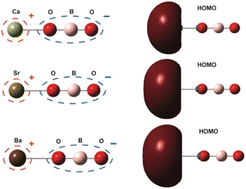
The BO2 molecule is a superhalogen with a very high electron affinity, resulting in an extremely stable BO2− anion suitable as a building block to form ionic compounds. Here we report the generation of M(BO2−) (M = Ca, Sr, Ba) complexes and the investigation of their structures and bonding using high-resolution cryogenic photoelectron imaging. All three M(BO2−) alkaline-earth complexes are found to have linear M(O–B–O−) (1Σ+) structures. Photodetachment removes an electron from the alkaline-earth metal atom and produces the neutral M+(O–B–O−) (2Σ+) ionically bonded ground state. The change of the charge state on the metal center induces a significant reduction of the M–O bond length in the neutral final state, resulting in an extensive M–O stretching vibrational progression in all the photoelectron spectra. The electron affinities of MBO2 are measured to be 1.574 eV, 1.487 eV, and 1.291 eV and the M–O stretching frequencies are measured to be 411 cm−1, 339 cm−1, and 290 cm−1 for M = Ca, Sr, and Ba, respectively. The strong electron-withdrawing power of BO2 leads to the ionically bonded ground state for MBO2 (2Σ+), resulting in a single electron localized on the metal center. The ionic interaction between M+ and BO2− in MBO2 makes their low-lying electronic excitations resemble atomic transitions, rendering MBO2-type molecules promising candidates for laser cooling.
- This article is part of the themed collection: 15th anniversary: Chemical Science community collection
 Please wait while we load your content...


