


High-resolution studies of photo(electro)catalysts by electrochemical scanning probe microscopy

Abstract
Photocatalytic processes are central to many energy and environmental applications; however, mechanistic understanding of these processes is incomplete. Traditional techniques provide bulk-averaged data, missing crucial activity variations between and within individual photocatalyst particles, which are challenging to probe due to their small size. Scanning electrochemical microscopy (SECM) and related techniques provide a unique spatially resolved perspective, enabling deeper insights into photocatalyst performance at the microscale and the nanoscale. In this article, we review applications of electrochemical scanning probe techniques in studies of particulate and two-dimensional photo(electro)catalysts and advancements in quantitative kinetic measurements and high-resolution mapping of CT and catalytic activity. The characterization of heterogeneous photocatalysts and co-catalysts using the recently developed tunnelling mode of photo-SECM and the expected synergy between amperometric and potentiometric nanoelectrochemical techniques are also discussed.
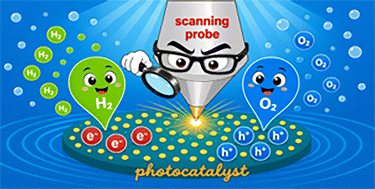
- This article is part of the themed collections: 2026 Chemical Science Perspective & Review Collection and 15th anniversary: Chemical Science community collection
 Please wait while we load your content...


