


Bioinspired thermal management fibers and textiles

Abstract
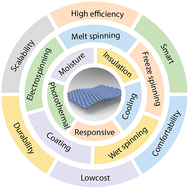
Thermal management fibers and textiles are crucial for the survival and adaptability of humans across various environments. However, traditional textiles are deficient in a dedicated heat transfer design and therefore fail to meet the demands of thermal management under extreme temperature environments. In this regard, animals such as polar bears, yaks, and camels have evolved hierarchical hairs and furs that exhibit efficient thermal management properties, enabling them to adapt to their specific habitats. Drawing inspirations from the unique hierarchical structures of animal hairs, advanced fibers and textiles have been developed for the effective regulation of heat exchange between the human body and the surroundings. In this tutorial review, we systematically summarize the state-of-the-art bioinspired thermal management fibers and textiles. First, the fundamental heat transfer principles of human body are outlined, followed by an introduction to the general heat transfer models applicable to textiles. Subsequently, typical natural fibers and hairs from diverse habitats are analyzed for their inherent thermal regulatory adaptations. Additionally, emerging fibers and textiles for thermal management are classified based on fabrication techniques, functions, and applications. Finally, current challenges and bottlenecks of bioinspired thermal management fibers and textiles are discussed to guide the future research. The discussion of interdisciplinary interactions of biology, materials science, and textile engineering in this review will further promote the development of the thermal management textile field in both academia and industry.
- This article is part of the themed collection: 2025 Pioneering Investigators
 Please wait while we load your content...


